
Carnival cruises have a very specific rhythm: boarding day energy, a ship that stays active from morning into late night, and just enough structure to keep everything moving while still feeling easy. The appeal is how quickly you settle in, lunch on Lido, a drink in hand, your first show, then waking up to a new port or an open-ocean sunrise.
When you understand the small rules that shape the experience, drinks, Wi-Fi, dining, documents, and timing, you spend less time troubleshooting and more time enjoying what Carnival does best: a vacation that feels effortless once you’re on board.
Here’s what to know before you sail.
Summary
- Clear, policy-based answers to the questions that affect cost, convenience, and onboard routines
- Drinks, packages, gratuities, and what’s included, so budgeting stays predictable
- What you can bring (soda, wine, snacks) and what gets restricted at embarkation
- Wi-Fi, check-in/boarding timing, and required documents for smooth sailing
1. How much are drinks on Carnival Cruise?
Drink prices on Carnival cruises can differ by ship and venue. In general, beer starts around $8, wine from $9.50+, cocktails run about $8–$20, and sodas are roughly $3 each. Final costs are higher because an 18–20% gratuity is added. The CHEERS! package is about $70–$85 per day, covers many drinks up to $20–$25, includes sodas and coffees, and has a 15-drink daily limit. Bottomless Bubbles is around $10 per day for sodas.
2. How much is a beer on Carnival Cruise?
Beer on a Carnival cruise usually costs about $7–$10 before gratuity. Domestic 16-oz beers are often around $7.75, while imports and craft beers typically range from $8.25 to $9.75+. An automatic 18% gratuity is added to every drink. If you have several beers daily, CHEERS! package may be a better value, and bucket specials can lower the per-beer cost.
3. How much is a soda on Carnival Cruise?
A soda on Carnival typically costs about $2.75–$3.00 per can, plus an 18% gratuity. If you plan to drink several sodas or juices each day, the Bottomless Bubbles package is usually a better value at around $11–$12 per adult/day, covering fountain sodas and juices at bars and restaurants. You can also pre-order 6-packs for roughly $10–$11.
4. How much is bottled water on Carnival Cruise?
A soda on Carnival typically costs about $2.75–$3.00 per can, plus an 18% gratuity. If you plan to drink several sodas or juices each day, the Bottomless Bubbles package is usually a better value at around $11–$12 per adult/day, covering fountain sodas and juices at bars and restaurants. You can also pre-order 6-packs for roughly $10–$11.
5. Can I bring a 12 pack of soda on Carnival Cruise?
Yes, Carnival allows each guest to bring up to 12 sealed, unopened cans or cartons of non-alcoholic drinks (like soda, juice, or sparkling water) that are 12 oz / 354 ml or smaller. These must be packed in your carry-on bag on embarkation day. Plastic and glass bottles aren’t allowed. A small wheeled bag or soft cooler can make carrying them easier through the terminal.
6. Can I bring soda on Carnival Cruise?
Yes, you can bring soda on a Carnival cruise, as long as it’s sealed cans or cartons (12 oz / 354 ml or less). The limit is 12 per person, and they must be packed in your carry-on on embarkation day. Plastic and glass bottles aren’t allowed, including bottled water. You can mix soda, juice, or sparkling water within the 12-item limit to save on onboard drink costs.
7. Can you bring bottled water on Carnival Cruise?
Carnival generally doesn’t allow guests to bring plastic or glass bottled water onboard. However, you can bring up to 12 sealed cans or cartons (12 oz or less) of non-alcoholic drinks, like sparkling water, per person on embarkation day in your carry-on. A practical alternative is bringing a refillable bottle for ship water stations, or pre-ordering water for stateroom delivery.
8. Can I bring wine on Carnival Cruise?
Yes, Carnival allows one sealed 750ml bottle of wine or champagne per adult (21+) on embarkation day, and it must be packed in your carry-on. Beer and hard liquor aren’t allowed. If you drink your wine in a dining room, specialty restaurant, or bar, a $15 corkage fee per bottle applies; it’s typically free to enjoy in your stateroom. Fortified wines over 15% ABV aren’t permitted.
9. Can I bring alcohol on Carnival Cruise?
Yes, but Carnival has tight rules. You may bring one sealed 750ml bottle of wine or champagne per adult (21+) in your carry-on on embarkation day. Beer and hard liquor aren’t allowed and will be confiscated. If you drink your wine in dining rooms or bars, there’s a $15 corkage fee per bottle. Non-alcoholic drinks are limited to 12 sealed cans/cartons (12 oz max) per person.
10. What drinks can I bring on Carnival Cruise?
On Carnival, you can bring one sealed 750ml bottle of wine or champagne per adult (21+), plus up to 12 sealed cans or cartons (12 oz or less) of non-alcoholic drinks per person, such as soda, juice, or sparkling water. Everything must be in your carry-on, no plastic or glass bottles are allowed. Beer and hard liquor are prohibited. A $15 corkage fee applies if you drink your wine in dining areas.
11. Can I bring snacks on Carnival Cruise?
Yes, you can bring snacks on a Carnival cruise, but they should be commercially packaged, unopened, and factory-sealed (think chips, crackers, candy, or granola bars). Homemade foods and fresh items like fruit are usually not allowed due to food safety rules. Keep portions reasonable and remember that port authorities may have restrictions when taking food ashore or bringing it back onboard.
12. What food and drink can you bring on Carnival Cruise?
On Carnival, you can bring factory-sealed, non-perishable snacks (chips, crackers, cookies, candy) and limited drinks in your carry-on: up to 12 cans/cartons (12 oz or less) per person, plus one sealed 750ml bottle of wine/champagne per adult (21+). Beer, hard liquor, and plastic/glass bottled drinks aren’t allowed. Homemade food, fresh fruit, meats, and cooked items are typically prohibited. A $15 corkage fee applies for wine in dining areas.
13. What can I bring on a Carnival Cruise?
On a Carnival cruise, you can bring essentials like passport/ID, boarding documents, and insurance info, plus 12 cans/cartons of non-alcoholic drinks per person and one 750ml wine/champagne per adult (21+) (carry-on). Pack prescription meds, sealed snacks, toiletries, and a non-surge power strip. Avoid prohibited items like irons/steamers, hard liquor, speakers, and weapons. Keep documents, meds, valuables, and a change of clothes in your carry-on.
14. What is included on a Carnival Cruise?
A Carnival cruise fare includes your stateroom, most dining (Main Dining Room, Lido buffet, and casual spots like Guy’s Burgers, BlueIguana, and pizza), plus basic drinks such as water (not bottled), coffee/tea, lemonade, and iced tea.
You also get shows, live music, pools, a fitness center, and kids’ clubs. Extras include soda, specialty coffee, alcohol, Wi-Fi, excursions, specialty dining, spa services, and photos. Bundles like Essentials or Ultimate Value can package popular add-ons.
15. What drinks are included on Carnival Cruise?
On Carnival, included drinks are simple basics: water, regular coffee, hot tea, iced tea, lemonade, hot chocolate, and some standard juices at breakfast. Everything beyond that, like soda, bottled water, specialty coffee, energy drinks, mocktails, and alcohol, costs extra unless you buy a package such as CHEERS! or Bottomless Bubbles. Guests can also bring up to 12 sealed cans/cartons (12 oz max) per person in carry-on.
16. Is Carnival Cruise all inclusive?
Carnival isn’t fully all-inclusive. Your fare covers your stateroom, most meals in the Main Dining Room and buffet, plus casual spots, and basic drinks like water, coffee, tea, lemonade, and some juices. You also get entertainment, pools, fitness center access, and kids’ programs. You’ll pay extra for alcohol, soda, specialty coffee, specialty dining, Wi-Fi, excursions, spa services, and photos, though value bundles can reduce add-on costs.
17. Is food free on Carnival Cruise?
Yes, most food on a Carnival cruise is included. Your fare covers the Main Dining Room, the Lido buffet, and popular casual spots like Guy’s Burger Joint, BlueIguana Cantina, and the pizzeria (options vary by ship). You’ll pay extra for specialty dining like the steakhouse or Chef’s Table. Free food is available from morning to late at night, so it’s easy to eat well without extra spending.
18. Is water free on Carnival Cruise?
Yes, Carnival provides free drinking water throughout the ship. You’ll find it at self-serve stations (often on the Lido deck), and your stateroom faucet is also drinkable. Bottled water costs extra unless it’s included with a qualifying beverage package, and Bottomless Bubbles doesn’t include bottled water. Many guests bring an empty reusable bottle to refill, or pre-order cases of bottled water to the cabin.
19. How much is Wi-Fi on Carnival Cruise?
Carnival’s Wi-Fi pricing depends on plan and whether you buy early. Typical pre-cruise prices start around $20.40/day for Social, $23.80/day for Value, and $25.50/day for Premium (per person, per day), with onboard prices usually higher. Multi-device plans can cost more but may be cheaper than buying separate plans.
20. How to get free Wi-Fi on Carnival Cruise?
Carnival doesn’t offer fully free internet at sea, but you can connect to the ship’s Wi-Fi to use the Carnival Hub App for schedules, menus, and ship info without buying a plan (chat may cost extra). For free Wi-Fi, use cafés or public hotspots in the port. To save money onboard, buy a Wi-Fi plan before sailing, use short-duration passes, or consider an eSIM option like GigSky if your phone supports it.
21. How much is a Carnival Cruise?
Carnival cruise prices vary widely by itinerary and timing. Short 3–5 night trips can start under $200, with many Bahamas or Mexico sailings around $200–$400 per person. A 7-day Caribbean cruise often begins around $500–$800+ for an interior cabin, with balconies and suites costing more. Budget extra for taxes/fees, gratuities, drinks, Wi-Fi, excursions, and specialty dining.
22. How much is gratuity on Carnival Cruise?
Carnival’s daily gratuities are typically $16 per person, per day for standard staterooms and $18 per person, per day for suites, automatically added to your onboard account to support dining, housekeeping, and behind-the-scenes crew. Separately, an 18% service charge is added to drinks, specialty dining, and spa services. You can prepay gratuities, and the daily amount can be adjusted at Guest Services, but drink/spa charges are usually not removable.
23. How much does a Carnival cruise captain make?
Carnival cruise ship captain pay isn’t officially published, but industry estimates often place it in the $140,000–$180,000 annual base range, with total compensation commonly reaching $200,000+ when bonuses are included. Earnings can vary based on ship size, experience, and performance metrics. Captains are senior leaders responsible for safety, operations, and thousands of guests and crew.
24. How much do Carnival cruise workers make?
Carnival crew pay depends heavily on the job and contract terms. Many shipboard roles earn a modest base monthly pay (often under $2,000–$3,000/month), and service positions may rely on tips or commission to raise total earnings. Higher-level leadership roles can pay far more. Room and meals are typically provided on board, which reduces living costs, but the work can involve long hours and months away from home.
25. How much does a Carnival cruise director make?
Carnival Cruise Director pay can vary a lot by experience and contract, but estimates often place total annual compensation around $135,000–$154,000, including bonuses. Reported ranges can start near $77,000 and reach $200,000+ in some cases. Some roles may have a lower base salary but include valuable perks like room and meals onboard, which can increase the overall value of the package.
26. How much does a Carnival cruise ship cost to build?
Carnival cruise ship build costs vary by age and size. Newer mega-ships can cost close to $1 billion, for example, Mardi Gras and Carnival Celebration are often cited at around $950 million each. Older ships built in the early 2000s are frequently estimated closer to $400–$500 million. Costs rise with ship size, LNG engines, newer tech, and big-ticket attractions like the BOLT roller coaster.
27. What documents do I need to cruise on Carnival?
Here’s what you typically need to cruise on Carnival:
- Boarding pass + luggage tags (printed or digital)
- Proof of citizenship/ID
- Best option: U.S. Passport Book (often recommended; some itineraries require it)
- Many travelers use a passport valid 6+ months past the cruise end date
- Closed-loop U.S. cruises: Government photo ID + certified birth certificate may work
Requirements vary by itinerary, so always confirm for your sailing.
28. Do you need passport for Carnival cruise?
A passport isn’t always required for U.S. citizens on closed-loop Carnival cruises (leaving and returning to the same U.S. port) to places like Mexico, the Caribbean, the Bahamas, Bermuda, or Canada. In those cases, a certified birth certificate + government photo ID may work.
That said, a passport book is strongly recommended for emergencies, flying home from a foreign port, and a smoother re-entry. Always confirm requirements for your specific itinerary.
29. Do you need a Real ID to go on a Carnival cruise?
You don’t need a REAL ID specifically to board a Carnival cruise. REAL ID rules mainly apply to domestic U.S. flights, not cruise check-in. For closed-loop cruises, many U.S. citizens can use a certified birth certificate + government photo ID (it doesn’t have to be REAL ID). A passport book is still the smoothest option, and an Enhanced Driver’s License (EDL) from select states may also qualify. Always match documents to your itinerary.
30. What is the earliest check-in time for Carnival cruise?
Carnival’s earliest arrival appointments are often around 10:00–10:30 AM, but the exact earliest time varies by port and ship. You choose a 30-minute Arrival Appointment during online check-in, and earlier slots can go quickly. Suite guests and Platinum/Diamond members may have priority. Even if you arrive early, cabins usually aren’t ready until around 1:30 PM, so plan to explore public areas first.
31. When can I check in for my Carnival cruise?
Carnival online check-in typically opens 14 days before sailing at 12:00 AM ET. Diamond, Platinum, and suite guests usually get earlier access at 16 days before. Checking in early helps you grab the best Port Arrival Appointment, which affects boarding time. Be sure to finish online check-in by midnight ET the day before sailing so you can download your boarding pass and luggage tags. Cabins are usually ready around 1:30 PM.
32. What time does Carnival cruise board?
Carnival boarding usually begins around 11:00–11:30 AM, but it depends on the ship and port. You’ll choose a Port Arrival Appointment during online check-in (often starting around 10:30 AM). Even if you board early, staterooms are typically ready around 1:30 PM, so many guests grab lunch on Lido first. Make sure you’re onboard by the final boarding time listed on your boarding pass (often 90 minutes before sailing).
33. How many bags can you bring on Carnival cruise?
Carnival doesn’t usually enforce a strict bag count, but they commonly recommend 1 checked bag per person for 3–5 nights and up to 2 checked bags per person for longer cruises, plus a carry-on/personal item for essentials. For easier handling and cabin storage, aim for under 50 lbs per bag and roughly 16″ x 24″ footprint. The real limit is what you can comfortably manage and store in your stateroom.
34. Can you smoke on Carnival cruise?
Smoking is allowed only in designated areas, which may include specific outdoor spots and, on some ships, a portion of the casino. Smoking in staterooms and balconies is typically prohibited and can lead to cleaning fees. The locations of smoking areas vary by ship, so once onboard, check the ship map or signage. If you’re sensitive to smoke, choose non-smoking zones.
35. What is the best Carnival cruise ship?
There isn’t one “best” Carnival ship for everyone; it depends on what you want onboard. If you’re after the newest features, big dining variety, and attractions like BOLT, the Excel-class ships (Jubilee, Celebration, Mardi Gras) are top picks. For a strong mix without the mega-ship feel, the Vista-class (Panorama, Horizon, Vista) is a favorite. If you prefer a cozier ship with a classic vibe, smaller ships like Carnival Pride can be a great choice.
36. What is the biggest Carnival cruise ship?
Carnival’s biggest ships today are the Excel-class: Carnival Jubilee, Carnival Celebration, and Mardi Gras. They’re all around 183,500+ gross tons, with Jubilee currently considered the largest by tonnage and guest capacity, while Mardi Gras is slightly smaller at roughly 180,000 gross tons.
These ships are known for big entertainment, lots of dining, and the BOLT roller coaster. Carnival has also announced Carnival Festivale (2027), expected to be even larger.
37. What is the largest Carnival cruise ship?
Carnival’s largest ships right now are the Excel-class: Carnival Jubilee, Carnival Celebration, and Mardi Gras. They’re all around 183,500 gross tons and carry about 5,300+ guests at double occupancy (with higher maximum capacity). Carnival Jubilee entered service in late 2023 and is currently the biggest in the fleet. Looking ahead, Carnival Festivale (2027) is expected to surpass them in size and guest capacity.
38. How big is a Carnival cruise ship?
Carnival ship sizes range from about 70,000 gross tons on smaller, older ships (like Carnival Elation/Paradise) to 183,500+ GT on the newest Excel-class ships (Jubilee, Celebration, Mardi Gras). The largest ships can be over 1,100 feet long and carry 5,300+ guests at double occupancy, while smaller ships are closer to 2,000–2,200 guests. Bigger ships mean more venues and attractions; smaller ships often feel simpler and can be a great value.
39. What is the smallest Carnival cruise ship?
Carnival’s smallest ships are typically Carnival Elation and Carnival Paradise, both older Fantasy-class vessels. Elation is slightly smaller by size (around 71,900 GT) and carries roughly 2,190 guests, while Paradise is about 71,900+ GT and carries around 2,124 guests at double occupancy. These ships feel more intimate than Carnival’s newest mega-ships, with fewer venues but a more classic cruise layout and atmosphere.
40. Does Carnival cruise have a gym?
Yes, Carnival ships have a fitness center (gym), and it’s free to use. You’ll usually find treadmills, bikes, ellipticals, weight machines, and free weights, often with great ocean views. The exact equipment can vary by ship. Fitness classes like yoga, Pilates, and cycling, plus personal training, cost extra. Gym access is typically for adults, with teens allowed under certain age rules and supervision policies.
41. Are there irons on Carnival cruise ships?
Carnival doesn’t allow irons in staterooms because of fire safety rules, and personal irons are typically not permitted either. If you need to press clothes, most ships provide launderettes or dedicated ironing rooms with irons and ironing boards on stateroom decks.
You can also use valet laundry/pressing for a fee through your cabin steward. If you want a simple backup, pack wrinkle-release spray or hang clothes in the bathroom while you shower.
42. Can you bring a fan on Carnival cruise?
Yes, you can usually bring a small portable fan for your cabin on a Carnival cruise. A compact USB or battery fan is the easiest option, and something under about 12 inches is practical for stateroom space. Avoid large box fans and don’t use a surge-protected power strip, since those aren’t allowed. Fans are meant for in-cabin comfort (airflow or white noise), not for use in dance floors or nightclubs, where handheld fans may be restricted.
43. Can you bring a steamer on a Carnival cruise?
No, clothes steamers aren’t allowed on Carnival cruises because they’re considered a fire and safety risk, and they can be confiscated during security screening. If you want wrinkle-free clothes, bring wrinkle-release spray, hang items in the bathroom while you take a hot shower, or use the ship’s launderette/ironing areas when available. Packing wrinkle-resistant fabrics can also reduce the need to press anything onboard.
44. Can you use cash on Carnival cruise?
Yes, you can use cash on a Carnival cruise, but most onboard purchases are cashless. Instead of paying cash at bars or shops, you load cash onto your Sail & Sign account at Guest Services or a kiosk, then use your room key card for everything onboard. The casino is a common exception where cash is used directly. Any leftover balance is returned, and cash is also handy for tips and spending in ports.
45. Are walkie talkies allowed on Carnival cruise ships?
Yes, walkie-talkies are generally allowed on Carnival, but they’re often not very reliable onboard. The ship’s steel structure blocks signals, so they may work only on open decks or short distances and can be spotty between decks. Many guests find the Carnival Hub App chat easier for staying connected (it’s usually a small fee). If you bring walkie-talkies, keep the volume low and consider using an earpiece to avoid disturbing others.
46. How many elegant nights on Carnival cruise?
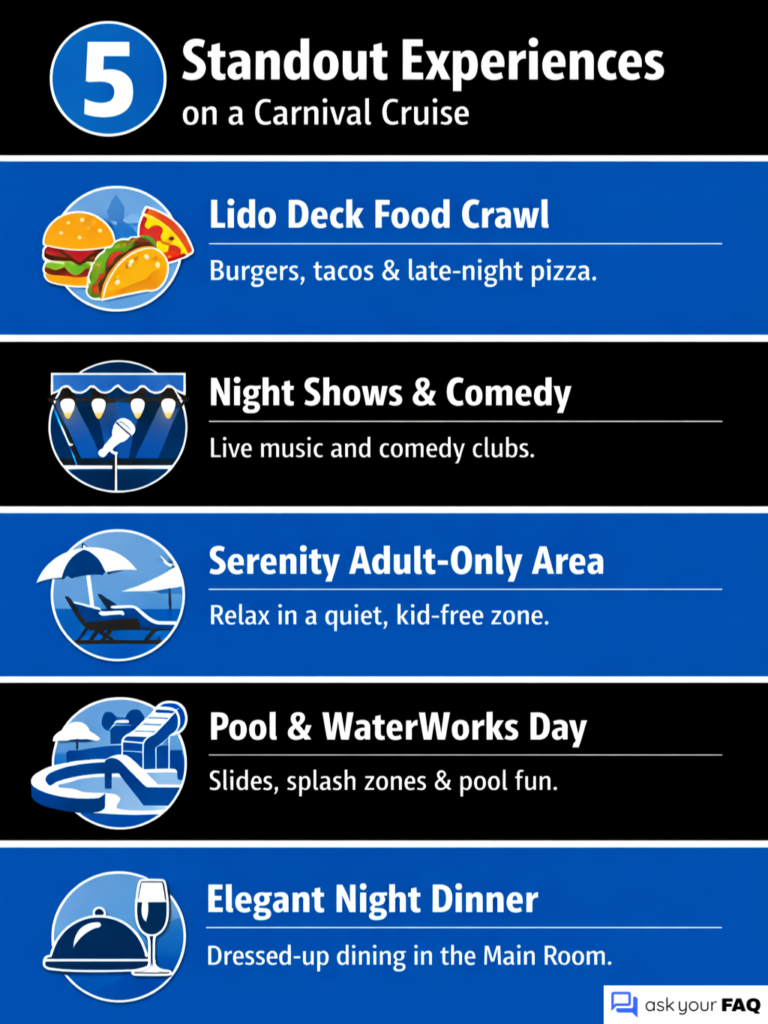
Carnival typically schedules one Elegant Night on shorter cruises (2–5 days) and two Elegant Nights on cruises 6 days or longer. They’re usually planned on sea days, often around the second night and then near the end of the trip (like the last sea day). Elegant Night is most noticeable in the Main Dining Room, where you’ll often see a more “special occasion” menu, sometimes featuring items like lobster or prime rib.
47. How many formal nights are on Carnival cruise?
Carnival usually has one Cruise Elegant night on 3–5 day cruises and two on cruises 6 days or longer. They’re commonly scheduled on sea days, often the 2nd or 3rd evening, and then another night close to the end (usually 2–3 nights before disembarkation, not the final night). The exact schedule depends on the itinerary, so check the Carnival Hub App or daily planner once onboard.
48. When is Elegant Night on Carnival 7 day cruise?
On most 7-day Carnival cruises, you’ll usually see two Elegant Nights, commonly around Day 2 and Day 6. These often line up with sea days or quieter port days, but the schedule can shift depending on your itinerary. Elegant Night mainly affects the Main Dining Room, where the menu is often upgraded (sometimes including lobster). Dressing up is optional, and the buffet stays casual. Check the Hub App or FunTimes onboard for exact dates.
49. Where is the Carnival cruise port in Miami?
Carnival cruises from PortMiami (Dodge Island), and your ship may use Terminal D, E, or F, depending on the sailing, so always confirm your terminal on your boarding documents before arriving. If you’re driving, follow the overhead terminal signs once you enter the port.
Parking is available near terminals and is commonly around $22/day (subject to change). Taxis and rideshares can drop you at the terminal entrance; some taxi routes use a flat rate from MIA to PortMiami.
50. Where to park for Carnival cruise Long Beach?
For Carnival cruises out of Long Beach, you can park at the on-site Cruise Terminal garage (231 Windsor Way), but it can fill quickly and has a 7 height limit. Rates are often around $23/day (can change).
Many guests save money by booking off-site parking through services like CruiseParking or ParkWhiz, or using nearby hotel cruise-parking packages, then taking a short shuttle or Uber/Lyft to the terminal. Booking ahead helps secure the best rate and spot.
51. What cruise lines does Carnival own?
Carnival Corporation owns several well-known cruise brands across different styles and markets. Its portfolio includes Carnival Cruise Line, Princess Cruises, Holland America Line, Seabourn, and Cunard, plus Europe-focused lines like Costa Cruises and AIDA Cruises.
It also operates P&O Cruises (UK) and P&O Cruises (Australia). Each brand is run separately, so the onboard experience can range from fun-focused and family-friendly to premium and ultra-luxury.
52. Is Princess Cruise Line owned by Carnival?
Yes, Princess Cruises is owned byCarnival Corporation & plc, the same parent company behind Carnival Cruise Line, Holland America Line, and Cunard. Princess became part of Carnival’s group after the company’s merger with P&O Princess Cruisesin 2003.
Even though they share ownership, Princess is positioned as a more premium-style cruise line, with a different onboard feel and pricing compared to Carnival Cruise Line.
53. How to cancel Carnival cruise?
Here’s how to cancel a Carnival cruise:
- Log in to your Carnival account and open My Cruise Details.
- Click the cancellation/penalty link (often “Is there a penalty for cancelling?”) to see your exact fees.
- Follow the prompts to cancel online, if available.
- If you booked through a travel agent, you must cancel through them.
- Keep in mind: fees usually increase closer to sailing, and insurance may help for covered reasons.
54. What does Carnival cruise insurance cover?
Here’s what Carnival Vacation Protection typically covers:
- Trip cancellation/interruption (for covered reasons)
- Baggage loss or delay
- Emergency medical + evacuation (often around $10,000 medical / $30,000 evacuation)
- May include a Cancel For Any Reason-style option that returns about 75% as Future Cruise Credit (not cash)
It’s a basic plan, so coverage limits can be lower, and it may not include every non-cruise expense.
55. How to change dining time on Carnival cruise?
Here’s how to change your dining time on a Carnival cruise:
- Log in to Carnival and check Manage My Booking / Cruise Manager for dining options.
- If your preferred time is full, visit the Maitre D in the Main Dining Room on embarkation day.
- Request Early, Late, or Your Time Dining (based on availability).
- Use the Carnival Hub App to monitor changes or waitlist updates.
- Keep in mind: dining changes depend on space and demand.
56. How to become a Carnival cruise travel agent?
Here’s the typical path to becoming a Carnival-focused travel agent:
- Join a host agency (or work with an established agency) to access booking tools and commissions.
- Build cruise knowledge with training like CLIA.
- Register on GoCCL.com and complete Carnival’s agent education programs.
- Market your services, match clients to the right ship/itinerary, and earn commission.
- Success comes from strong sales, organization, and customer support skills.
57. Is Carnival a good cruise line?
Yes, Carnival is generally considered a good cruise line, especially if you want a fun, lively, budget-friendly vacation. Your fare includes plenty of food, shows, and activities, and many ships have strong family features like kids’ clubs and water parks. The main trade-off is vibe: some sailings feel more energetic and crowded than others, and experiences can vary by ship and itinerary. If you prefer quiet luxury, a premium line may fit better.
Related Reads
Travel Insurance FAQ: What Coverage Do You Really Need Before Your Trip?
25 Event FAQ Questions Attendees Always Ask (With Sample Answers)