
Trading can feel simple at first: pick a market, place a trade, and hope it moves your way. But real trading is about process. You need a strategy to stay consistent, indicators to read price behavior, and leverage knowledge to avoid costly mistakes. Most importantly, you need risk controls so one bad trade doesn’t wipe out weeks of progress.
This FAQ is built to answer the questions traders search for most clearly, in the right order, and without jargon. Use it as a practical guide, whether you’re new to trading or tightening up your approach.
Getting Started & Core Concepts
1. What is trading, and how is it different from investing?
Trading is the act of buying and selling financial instruments to profit from price movement, often over shorter timeframes like minutes, hours, or days. Investing is usually longer-term and focuses on building wealth gradually through holding assets for months or years. Traders care more about timing, entries, exits, and risk control, while investors focus more on company value, growth, and long-term trends. Both can work, but trading requires faster decisions and stricter discipline because market moves can impact results quickly.
2. What are the main markets traders participate in (Forex, indices, stocks, commodities, crypto)?
Traders usually choose markets based on volatility, trading hours, and risk level:
- Forex (Foreign Exchange): Currency pairs like EUR/USD, GBP/JPY. High liquidity and popular for leverage trading.
- Indices: Like S&P 500, NASDAQ, DAX. Great for trend moves and macro-driven trading.
- Stocks: Individual companies. Can be stable or volatile depending on the stock and news.
- Commodities: Gold, oil, coffee, sugar, soybeans. Strong moves during global events and seasonal changes.
- Crypto: Bitcoin, Ethereum, altcoins. Very volatile and risky, but offers opportunities for quick price moves.
3. What are CFDs, and how do they work in simple terms?
A CFD (Contract for Difference) lets you trade price movement without owning the actual asset. You don’t buy physical gold or real company shares; you simply trade whether the price will go up or down. If the price moves in your direction, you profit. If it moves against you, you take a loss. CFDs are popular because they allow leverage and short-selling, but they also carry higher risk because losses can grow fast if you trade with large exposure.
4. Can you trade both rising and falling markets, and how do long vs short trades work?
Yes, and this is one reason CFDs and margin trading are so popular.
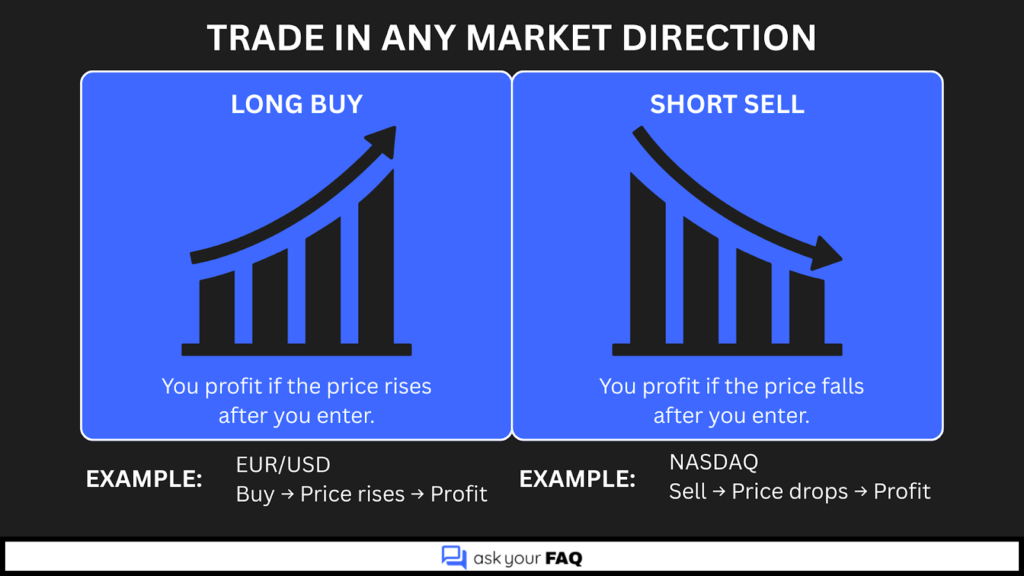
Short trades are powerful, but they still require stop-loss protection because the price can reverse quickly.
5. What is volatility in trading, and why does it matter?
Volatility means how fast and how strongly the price moves. High volatility creates more trading opportunities, but it also increases risk because the price can hit your stop-loss faster or trigger slippage. Low volatility can feel “safe,” but it may also lead to slow movement and fewer setups. The best approach is not to chase volatility blindly, but to trade instruments you understand and adjust your position size based on how much they move daily.
Trading Strategies
6. What is a trading strategy, and why do most traders fail without one?
A trading strategy is a set of rules that tells you when to enter, where to exit, and how much to risk. Without a strategy, traders usually make random decisions based on emotion, social media hype, or fear of missing out. That leads to inconsistent results and repeated mistakes. A strategy doesn’t need to be complicated; it just needs to be clear enough that you can follow it even when the market feels stressful or uncertain.
7. What’s the difference between day trading, swing trading, and position trading?
These styles differ mainly by holding time:
- Day trading: Trades opened and closed within the same day. Fast decisions require time and focus.
- Swing trading: Trades held for days to weeks. More patience, less screen time.
- Position trading: Trades held for weeks to months. More like “long-term trading,” less noise.
Choose a style that fits your schedule and personality. The best strategy is the one you can repeat consistently.
8. What is swing trading, and who is it best for?
Swing trading focuses on capturing medium-term moves instead of chasing small price changes. Swing traders often use daily and 4-hour charts to find trend direction, key levels, and entry points. This style is best for people who cannot sit in front of charts all day, but still want active trading. Swing trading also reduces stress compared to scalping because trades have more “breathing room,” especially when combined with proper stop-loss placement.
9. What is scalping, and why is risk higher with fast trades?
Scalping is a strategy where traders take very short trades, sometimes lasting seconds to minutes. The goal is to collect small profits many times. The risk is higher because scalpers often use larger position sizes and tight stops. One bad entry, spread spike, or slippage event can wipe out multiple winning trades. Scalping requires quick execution, strict discipline, and strong control over emotions; it turns into overtrading very fast.
10. What is trend trading, and how do traders confirm a trend?
Trend trading means trading in the direction of the market’s momentum.
Traders often confirm trends using:
- Higher highs and higher lows (uptrend)
- Lower highs and lower lows (downtrend)
- Moving averages (optional confirmation)
- Breakouts + retests at key levels
- Momentum indicators like RSI/MACD
Trend trading is popular because it helps traders avoid fighting the market.
11. What does “high-probability setup” mean, and how do traders filter for better trades?
A high-probability setup is a trade idea that matches your best conditions.
Ways to filter better trades:
- Trade only at key support/resistance zones
- Trade with the main trend, not against it
- Avoid “middle of nowhere” entries
- Confirm with clear candle behavior
- Use a stop-loss that makes sense logically
- Skip trades during high-impact news
- Only trade when risk-reward is acceptable (example: 1:2)
More trades don’t mean more profit. Better trades usually win in the long term.
12. How many trades per day is “too many,” and how do you avoid overtrading?
Overtrading depends on your strategy, but common signs include:
- You trade even when setups aren’t clear
- You enter trades out of boredom
- You increase the lot size after losses
- You stop following your rules
To avoid overtrading:
- Set a daily trade limit (example: 2–5 trades max)
- Trade only during your best session
- Use a checklist before entering
- Stop trading after 2 consecutive losses
- Focus on quality, not activity
13. What is hedging in trading, and when does it actually make sense?
Hedging is opening a trade that offsets another trade’s risk. Traders hedge to reduce exposure during uncertainty or major news. For example, someone holding a long position might open a short position to protect against a temporary drop. Hedging can be useful, but it’s not a magic fix. If done without a plan, it can create double losses, extra costs, and confusion. Beginners should master stop-loss and position sizing before trying advanced hedging.
14. How do traders use multi-timeframe analysis without confusion?
Multi-timeframe analysis helps you align the “big picture” with the entry timing.
A simple way:
- Daily chart: overall trend + major zones
- 4H chart: structure + key breakouts
- 1H or 15M: entry trigger + stop placement
Rule: Don’t trade against the higher timeframe trend unless your strategy is built for reversals.
Indicators & Technical Tools
15. What are trading indicators, and what can they realistically tell you?
Indicators are tools that use price and volume data to highlight patterns like momentum, trend direction, or volatility. They can help you confirm ideas, but they cannot predict the future. Many traders lose money by relying on indicators alone without understanding market structure. The best way to use indicators is as support, not as the main decision-maker. Price action and risk management still matter more than any indicator setting.
16. Which indicators are best for beginners (and why fewer is better)?
Beginner-friendly indicators include:
- RSI: helps spot momentum and exhaustion
- Moving Average: a simple trend direction tool
- Bollinger Bands: volatility and expansion/contraction
- MACD: momentum and trend shift confirmation
Why fewer is better:
- Too many indicators give mixed signals
- More signals = more confusion
- Simple charts make decision-making faster
- Strategy execution becomes consistent
Start with 1–2 indicators and master them.
17. What is RSI, and how do traders use it correctly?
RSI (Relative Strength Index) measures momentum and helps traders understand whether the price is moving too strongly in one direction. Many traders think RSI overbought means “sell” and oversold means “buy,” but that’s not always true. In strong trends, RSI can stay overbought or oversold for long periods. A better use is to combine RSI with trend direction and key levels. RSI works best as confirmation, not as a standalone entry tool.
18. What is MACD, and what does it measure?
MACD (Moving Average Convergence Divergence) measures momentum and trend shifts. Traders watch MACD crossovers, histogram changes, and divergence signals to spot possible turning points. MACD can help confirm whether a trend is strengthening or losing momentum. However, it can lag during fast moves because it is based on moving averages. Many traders use MACD as a “trend confirmation” tool rather than an exact entry trigger.
19. What are Bollinger Bands used for?
Bollinger Bands show volatility by expanding when markets are moving strongly and contracting during quiet periods. When bands tighten, traders often expect a bigger move soon. When bands widen, the market may already be moving aggressively. Bollinger Bands can help traders understand whether the price is stretched away from the average, but it’s not a guaranteed reversal signal. The bands work best when paired with support/resistance and trend direction.
20. What is the Stochastic Oscillator, and when is it useful?
The Stochastic Oscillator is a momentum indicator that compares the closing price to a price range over time. Traders use it to spot momentum shifts, overbought/oversold zones, and possible reversals. It can be useful in sideways markets where the price repeatedly moves between support and resistance. In strong trends, it may give many false signals, so it’s best used with structure, trend confirmation, and clear risk controls.
21. How do traders combine indicators with support/resistance and price action?
A clean combination looks like this:
- Mark key support/resistance zones
- Identify trend direction from a higher timeframe
- Wait for the price to reach your zone
- Look for price action signals (rejection, breakout, retest)
- Use indicator confirmation (RSI/MACD)
- Place stop-loss beyond the structure
- Target the next logical level for take-profit
Indicators confirm. Structure decides.
22. Can indicators work alone, or should they always be paired with a strategy?
Indicators alone are not enough because markets change behavior. A strategy provides rules for entries, exits, and risk. Indicators are only tools that support your plan. Many traders fail because they chase indicator signals without understanding where the price is in the bigger picture. The best traders use indicators as confirmation, not as decision makers. If you can’t explain why you’re entering a trade beyond “RSI is oversold,” you’re likely gambling.
23. What is a false signal, and how can traders reduce them?
False signals happen when an indicator gives a “buy” or “sell” sign, but the price quickly reverses.
To reduce false signals:
- Trade with the trend
- Avoid low-liquidity times
- Use higher timeframes for confirmation
- Don’t trade in the middle of a range
- Combine indicators with key levels
- Wait for candle confirmation
- Keep risk per trade small
You can’t remove false signals completely, but you can reduce them.
Leverage & Margin
24. What is leverage in trading, and why is it called a double-edged sword?
Leverage allows you to control a larger position using a smaller amount of your own money. It’s called a double-edged sword because it magnifies both profits and losses. With leverage, small price moves can create meaningful gains, but the same small move against you can damage your account quickly. Leverage is not “bad,” but it becomes dangerous when traders use it without stop-losses, position sizing, and emotional discipline.
25. What is margin, and how is it different from leverage?
Margin is the amount of your capital required to open and maintain a leveraged trade. Leverage is the multiplier that determines how much exposure you can control with that margin. Think of margin as your deposit and leverage as the borrowing power. Many beginners focus only on the small margin amount and forget the real exposure they are holding in the market. That’s why margin trading can feel easy at first, but it becomes risky quickly without control.
26. What does a leverage ratio like 1:30, 1:100, or 1:500 actually mean?
Leverage ratios show how much market exposure you control per $1 of margin.
- 1:30 leverage: $1 controls $30 exposure
- 1:100 leverage: $1 controls $100 exposure
- 1:500 leverage: $1 controls $500 exposure
Higher leverage means a smaller margin needed, but also faster gains/losses.
27. How is the margin requirement calculated (simple example)?
Simple formula:
Margin Required = Position Size / Leverage
Example:
- You open a $10,000 trade
- Your leverage is 1:100
- Margin required = 10,000 / 100 = $100
So you control a $10,000 exposure with a $100 margin. That’s why risk control matters.
28. What is “effective leverage,” and why is it more important than broker leverage?
Effective leverage is the real leverage you’re using based on your total open positions compared to your account size. Even if a broker offers 1:500, you may only be using 1:10 if your position size is small. This matters because risk comes from exposure, not the leverage option shown in the account settings. Many traders blow accounts not because the broker’s leverage is high, but because they open positions too large for their balance.
29. Is higher leverage always riskier, or does position size matter more?
Position size matters more than the leverage number itself. High leverage simply makes it easier to open oversized trades. If your position size is controlled and your stop-loss is planned, you can trade safely even with leverage available. But if you use large lot sizes, even 1:30 can be risky. The real danger is trading too big, stacking multiple positions, or holding trades without stop-loss protection.
30. What are common beginner mistakes with leverage?
Common leverage mistakes include:
- Using maximum leverage “because it’s available.”
- Trading large lot sizes on small accounts
- No stop-loss or moving stop-loss further away
- Adding more trades to “recover” losses
- Holding positions during major news events
- Not checking the margin level and free margin
- Treating leverage like a shortcut instead of a tool
31. What is negative balance protection, and what does it not protect you from?
Negative balance protection prevents your account from going below zero in extreme situations. It protects you from owing money to the broker after sudden market spikes. However, it does not protect you from losing your entire balance. Traders sometimes feel “safe” because of this feature, but the truth is, you can still lose everything if you trade too big or ignore risk controls. It’s a safety net, not a trading plan.
32. Which markets typically offer higher leverage and why (Forex vs stocks vs crypto)?
Leverage varies by broker and regulation, but generally:
- Forex: often higher leverage due to high liquidity
- Indices: moderate leverage, strong moves during news
- Stock CFDs: lower leverage due to gap risk
- Crypto: leverage exists, but is risky due to extreme volatility
- Commodities: leverage varies, often volatile in event-driven moves
Always adjust position size based on volatility, not just leverage.
Margin Calls, Stop-Out, Slippage & Execution Risks
33. What is a margin call, and when does it happen?
A margin call happens when your account equity drops too low to maintain open trades. This usually occurs when trades move against you, and your free margin becomes too small. The broker may warn you to deposit funds or reduce exposure. If you don’t act and losses continue, positions can be closed automatically. Margin calls are stressful, but they are also avoidable with proper stop-loss placement and smart position sizing.
34. What is stop-out/liquidation, and how is it different from a margin call?
A margin call is a warning. A stop-out (or liquidation) is an action. Stop-out happens when your account reaches a critical margin level, and the platform automatically closes your open trades to prevent deeper losses. Traders often confuse the two, but stop-out is more serious because it means the broker closes positions without asking. This usually happens when traders over-leverage, stack trades, or refuse to accept small losses early.
35. How can traders avoid margin calls in real trading conditions?
To avoid margin calls:
- Use stop-loss on every trade
- Keep risk per trade low (example: 1%–2%)
- Avoid oversized positions
- Don’t stack correlated trades
- Watch your free margin regularly
- Reduce exposure before major news
- Don’t hold losing trades hoping they recover
- Keep an extra margin available for volatility
36. What is slippage, and when is it most common?
Slippage happens when your order is filled at a different price than expected.
It’s common during:
- Major economic news releases
- Low-liquidity sessions
- Market open/close periods
- Fast breakouts and sudden spikes
- High volatility instruments like crypto
Slippage can increase losses, so avoid trading heavily during unstable times.
37. What is liquidity risk, and how does it impact entries and exits?
Liquidity risk is the risk that you can’t enter or exit trades smoothly because there aren’t enough buyers and sellers at your desired price. In low liquidity, spreads can widen, and orders may fill poorly. This is especially important for scalpers and high-leverage traders because small execution issues can turn into big losses. Liquidity risk is higher during quiet sessions, holidays, or sudden market shocks.
38. How do major news events affect leverage trading?
Major news events can cause sudden spikes, fast reversals, and unpredictable price movement. When leverage is involved, even a small unexpected move can hit stop-losses instantly or trigger margin issues. Events like interest rate decisions, inflation reports, and jobs data often increase volatility. Many experienced traders reduce position size, tighten risk, or avoid trading right before news. Waiting 10–15 minutes after the news can help the market settle.
Risk Controls (Risk Management)
39. What is risk management in trading, and why does it matter more than strategy?
Risk management is how you protect your account from large losses. A strategy can be good, but if your risk is uncontrolled, one bad trade can wipe out many wins. Risk management includes stop-loss, position sizing, risk per trade, and limiting total exposure. Traders who survive long-term focus on protecting capital first. Once your account is safe, profits become easier because you’re not trading under pressure or fear.
40. What is a stop-loss, and where should you place it?
A stop-loss closes your trade when the price hits a defined level.
Good stop-loss placement ideas:
- Beyond the recent swing high/low
- Outside support/resistance zone
- Past a structure break point
- Based on volatility (not random numbers)
Bad stop-loss placement:
- Too tight with no logic
- Moving it further away to “avoid loss.”
- Not using one at all
41. What is a take-profit, and how do traders set realistic targets?
A take-profit locks gains when the price reaches your target.
Realistic target methods:
- Next support/resistance zone
- Previous high/low levels
- Trend continuation targets
- Risk-reward approach (example: 1:2 or 1:3)
A good take-profit is planned before entering, not decided emotionally mid-trade.
42. What is position sizing, and how do you calculate it step-by-step?
Position sizing decides how big your trade should be.
Simple steps:
- Choose account risk per trade (example: 1%)
- Know your stop-loss distance (example: 20 pips)
- Calculate risk amount (example: $1,000 account → 1% = $10)
- Adjust lot size so a 20-pip loss equals $10
- Place a trade only if the size fits your risk plan
This prevents random sizing and protects your account.
43. What is a good risk per trade for beginners (1% rule, 2% rule)?
For beginners, risking 1% per trade is a smart starting point because it allows room to learn without heavy damage. Even experienced traders often stay within 1%–2%. Higher risk may grow profits faster, but it also increases emotional pressure and account drawdowns. If your strategy is not fully tested, risking a small amount is the safest path. The goal early on is survival and consistency, not fast money.
44. What is a trailing stop, and when should you use it?
A trailing stop is a moving stop-loss that follows the price as your trade goes into profit. It helps you protect gains while still giving the trade room to grow. Traders use trailing stops in trending markets when the price moves strongly, and they want to stay in the trade longer. However, trailing stops can close trades too early in choppy markets. It works best when the market is trending, and your trailing distance matches volatility.
45. What is diversification in trading, and does it help traders or only investors?
Diversification means spreading risk across different instruments instead of relying on one market. Investors use it heavily, but traders can benefit too, especially by avoiding overexposure to correlated assets. For example, trading EUR/USD and GBP/USD at the same time can double risk because they often move similarly. Diversification helps reduce the chance that one market event destroys your entire portfolio. But it only works if each position is sized correctly.
46. How do you manage risk when trading multiple positions at once?
Managing multiple trades requires a portfolio mindset:
- Limit total risk across all trades (example: max 3% total)
- Avoid stacking correlated positions
- Keep enough free margin
- Use stop-loss on every trade
- Don’t open new trades just to “recover” losses
- Reduce size when volatility increases
- Review exposure before holding overnight
Psychology & Discipline
47. Why do traders engage in revenge trade, and how do you stop it?
Revenge trading happens when you try to “win back” losses emotionally.
How to stop it:
- Take a break after a loss
- Set a daily loss limit
- Use a smaller size after losing streaks
- Follow your checklist only
- Accept losses as part of trading
- Journal what triggered the behavior
48. How do fear and FOMO damage trading results?
Fear makes traders exit too early, skip good setups, or hesitate at entry. FOMO (fear of missing out) pushes traders to enter late, chase breakouts blindly, and ignore risk rules. Both are emotional reactions, not strategy-based decisions. The best way to reduce fear and FOMO is to have a clear plan and accept that you won’t catch every move. Consistency comes from following your rules, not catching every opportunity.
49. What does a “probability mindset” mean in trading?
A probability mindset means understanding that no single trade defines your success. Even the best setups can lose. Trading is about taking many trades with an edge and letting the numbers work over time. When you think in probabilities, you stop needing to be “right” on every trade. Instead, you focus on executing your plan, controlling risk, and trusting your process. This mindset reduces stress and helps you stay consistent.
50. What is a trading journal, and what should you track in it?
A trading journal records your trades so you can improve.
Track:
- Instrument and timeframe
- Entry and exit price
- Stop-loss and take-profit
- Position size and risk %
- Reason for entering (setup)
- Result (win/loss + notes)
- Emotions during the trade
- Mistakes and lessons learned
A journal turns trading into a skill, not a guessing game.
51. How long should you test a strategy before trusting it with real money?
You should test a strategy long enough to see how it performs across different market conditions. A good starting point is 25–50 trades, but more is better. Testing should include both winning and losing periods because real markets are not always trending or calm. Demo trading is useful, but live trading with a small size teaches real emotional control. Don’t increase risk until you have consistent results and clear proof that the strategy works.
Platforms & Practice
52. Should you start with a demo account, and what should you test first?
Yes, demo accounts help you practice safely.
Test these first:
- Order placement (market/limit/stop orders)
- Stop-loss and take-profit execution
- Strategy rules and timing
- Risk per trade consistency
- Trading sessions and volatility
- Journaling habits
Demo builds skill before money is involved.
53. What platform features matter most for leveraged trading (execution, risk tools, spreads)?
Key platform features include:
- Fast execution and stable connection
- Tight spreads and low trading costs
- Clear margin and free margin display
- Stop-loss and take-profit tools
- Risk calculator or position sizing tools
- Reliable charts and indicators
- Easy trade management on mobile/desktop
Good tools don’t guarantee profits, but they reduce mistakes.
54. What is the safest way to increase leverage over time?
Safe leverage growth looks like this:
- Start with low risk (1% per trade)
- Trade small sizes until consistent
- Increase only after proven results
- Don’t scale up during losing streaks
- Keep margin free and exposure controlled
- Focus on consistency before aggression
Leverage should match your skill, not your excitement.
55. What is a simple “pre-trade checklist” to avoid bad trades?
Use this before every trade:
- Is the trend clear on a higher timeframe?
- Am I trading at a key level?
- Do I have a valid setup signal?
- Is my stop-loss placed logically?
- Is the risk per trade within my limit?
- Is risk-reward worth it (1:2+)?
- Am I calm and focused?
- Any major news coming soon?
If you can’t tick the boxes, skip the trade.
Before You Place the Next Trade
Trading becomes easier when you stop chasing quick wins and start building a repeatable process. A clear strategy keeps you focused, indicators help you read the price better, and leverage only works when risk is controlled. Use stop-losses, size positions with care, and avoid trading heavily during unstable news moments. Track your trades, learn from patterns, and keep your rules simple enough to follow every day. If you do these basics well, you’ll trade with more control, less stress, and better long-term results.