

Self storage decisions depend on more than unit size. The right option is determined by what you’re storing, how long you need it, and how often you need access. Factors like item sensitivity (heat, moisture), security needs, facility rules, and whether insurance is included can affect both cost and suitability.
This FAQ explains the key variables that shape unit selection, pricing, access policies, and protection options. It’s designed to help you compare facilities using clear criteria and avoid issues that surface after move-in.
Summary
- Cost: Self storage pricing depends on unit size, location, access type (drive-up vs indoor), and climate control. Most rentals are month-to-month, and rates can change with demand and occupancy.
- Use & access: Suitability is driven by what you’re storing, how long you need storage, and how often you need access, plus facility rules, access hours, and operational reliability.
- Risk & terms: Contracts often limit facility liability, so insurance requirements, pest and moisture exposure, security controls, and rate-increase/lockout clauses should be reviewed before move-in.
1. What is self storage?
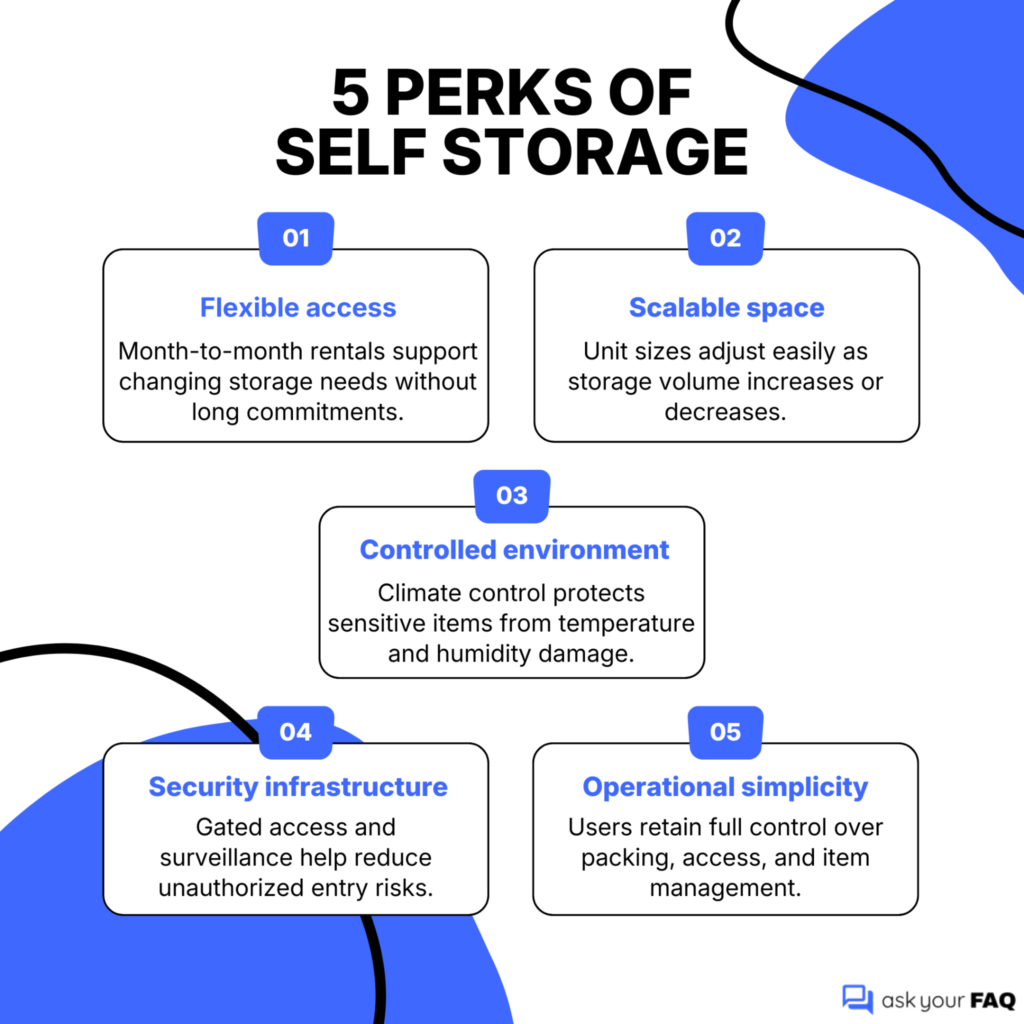
Self storage refers to rented, secured spaces where individuals or organizations store belongings outside their primary location. Units vary in size, access type, and environmental controls to accommodate different storage needs. The arrangement is typically short- or long-term, with users retaining responsibility for their stored items while the facility provides space, security infrastructure, and controlled access.
2. How does self storage work?
- Unit selection: Choose a unit based on size, access type, and environmental requirements.
- Agreement setup: Sign a rental agreement outlining permitted use, access rules, and liability limits.
- Move-in: Transport and place items independently; facilities do not handle stored goods.
- Access & use: Enter the unit during approved hours using gated or coded access systems.
- Ongoing management: The facility maintains security and infrastructure, while the renter manages contents, organization, and insurance.
3. What is self storage business?
The self storage business involves owning or operating facilities that lease storage units to customers. Revenue is generated through monthly rentals, ancillary services, and access-related features. The business model emphasizes space utilization, occupancy rates, operational efficiency, regulatory compliance, and location demand rather than active handling of customer goods.
4. Is self storage considered industrial?
Self storage is often classified as a light industrial or commercial real estate use, depending on zoning definitions. While facilities share characteristics with industrial properties, such as warehouse-style construction, they primarily serve consumer and small business needs. Classification varies by jurisdiction and affects land use permissions, taxation, and development regulations rather than day-to-day operations.
5. How much does self storage cost?
Self storage costs vary based on unit size, location, access type, and climate control. Urban markets and climate-controlled units typically cost more, while smaller or outdoor units are less expensive. Pricing is usually month-to-month and may change over time due to demand, promotions, or facility occupancy levels.
6. How much to charge for storage per month?
Storage pricing is generally set by evaluating local market rates, unit size, demand patterns, and operating costs. Operators also factor in vacancy tolerance, seasonal fluctuations, and value-added features such as climate control or extended access. Rates are typically adjusted over time to reflect occupancy and market conditions rather than fixed long-term pricing.
7. How much does a 16 foot pod cost per month?
A 16-foot portable storage container is usually priced based on delivery, pickup, and monthly storage duration. Costs vary by provider, location, and whether the container is stored onsite or at a facility. Monthly fees often increase if long-term storage or multiple relocations are involved.
8. Are pods cheaper than a storage unit?
Pods are not always cheaper than traditional storage units. While they offer convenience through delivery and flexible placement, they often include transportation and handling fees. Storage units may be more cost-effective for long-term use, especially when frequent access, fixed location, or larger capacity is required.
9. Is it cheaper to rent a storage unit or buy a shed
The cost comparison depends on duration and use. Renting a storage unit spreads costs monthly and includes security and location management. Buying a shed involves higher upfront expense, land availability, and maintenance responsibilities, but it may be more economical for long-term, static storage on owned property.
10. How to pack a self storage unit?
Packing a self storage unit involves planning for space efficiency and accessibility. Items are typically cleaned, boxed, and labeled before storage. Heavier items are placed at the back or bottom, with lighter goods stacked above. Clear walkways and vertical stacking help maintain access while reducing the risk of damage over time.
11. Can you store cars in self storage?
Cars can be stored in self storage facilities that offer vehicle-compatible units or designated parking spaces. Requirements often include proof of ownership, insurance, and a non-leaking condition. Indoor units provide additional protection from the weather, while outdoor storage is more common for short-term or larger vehicles.
12. Can you live in a self storage unit?
Living in a self storage unit is not permitted. Storage facilities are not zoned or equipped for habitation and typically prohibit occupancy under their rental agreements. Units lack required safety features such as ventilation, sanitation, and emergency access, making residential use unsafe and noncompliant with local regulations.
14. Is self storage a good investment?
Self storage can be a viable investment depending on location, demand stability, and operational execution. The asset class is often evaluated for its relatively low staffing needs, flexible lease structures, and resilience across economic cycles. However, outcomes vary based on land costs, competition, financing terms, and the ability to maintain consistent occupancy over time.
15. Are self storage facilities profitable?
Self storage facilities can be profitable when occupancy rates, pricing strategy, and operating costs are well managed. Profitability depends on factors such as acquisition or development costs, local supply levels, and ongoing maintenance expenses. Facilities in dense or growing markets tend to perform differently from those in oversupplied or low-demand areas.
16. Is self storage a good business?
As a business, self storage offers operational simplicity relative to many service-based models. Revenue is primarily space-driven rather than labor-driven, and customer interactions are limited. That said, success depends on disciplined pricing, location selection, marketing execution, and compliance with zoning, safety, and consumer protection regulations.
17. How much do self storage owners make?
Earnings for self storage owners vary widely. Income is influenced by facility size, market rents, debt structure, and operating efficiency. Small single-site owners may generate modest cash flow, while larger portfolios benefit from scale. Reported figures often reflect gross revenue or net operating income rather than owner take-home earnings.
18. Why are there so many self storage places?
The growth of self storage facilities is tied to urbanization, mobility, and space constraints. Population movement, smaller living spaces, and business storage needs contribute to demand. From a development perspective, facilities are relatively quick to build and adaptable to varied parcels, making them an attractive option in many real estate markets.
19. Do self-storage units have electricity?
Most self-storage units do not include individual electrical outlets. Facilities typically reserve electricity for common areas, security systems, and lighting outside units. Some specialized or premium facilities may offer powered units for approved uses, but availability is limited and regulated. Customers should confirm electrical access and usage restrictions directly with the facility before renting.
20. Can investigators learn that I have a self storage unit?
Self storage rentals are private but not anonymous. Facilities maintain customer records for billing and legal compliance. Investigators may access this information only through lawful processes such as subpoenas or court orders. Operators generally do not disclose customer details voluntarily, and access is governed by privacy laws and contractual obligations.
21. Is the owner of a self-storage facility responsible for damage caused by mice?
Responsibility for rodent-related damage is typically limited. Most self storage agreements place the risk of stored items on the renter and disclaim liability for pests. Facility owners are generally responsible only if negligence can be demonstrated, such as failing to maintain basic property standards. Liability outcomes depend on contract terms and applicable local laws.
22. As a self storage owner, do I need a self storage insurance policy?
Yes, self storage owners generally need insurance to cover property damage, liability risks, and operational exposure. Policies commonly address buildings, common areas, employee liability, and third-party claims. Insurance requirements vary by jurisdiction and lender, and coverage is separate from tenant insurance, which typically protects stored goods rather than facility assets.
23. What is it like to run a self-storage facility?
Running a self-storage facility centers on asset management rather than daily service delivery. Responsibilities typically include pricing oversight, occupancy management, facility maintenance, security monitoring, and regulatory compliance. Customer interaction is limited compared to service businesses, but performance depends on location strategy, demand tracking, marketing execution, and disciplined cost control over time.
24. Do self storage facilities need to be staffed?
Staffing requirements vary by facility size, technology adoption, and service model. Many modern self storage facilities operate with minimal or part-time staff, supported by automated access systems, remote monitoring, and online rentals. Larger or premium locations may require on-site personnel for customer support, maintenance coordination, and compliance with local operational regulations.
25. What to look for in a self storage place?
- Cleanliness and pest control: Look for clean hallways, sealed units, and visible pest prevention practices.
- Elevation and flooding risk: Prefer higher ground, good drainage, and units not directly exposed to runoff.
- Door type and loading ease: Roll-up vs swing doors, drive-up access, and how close you can park to the unit.
- Move-in support: Carts/dollies, elevators, wide hallways, and loading bays for larger items.
- Security and visibility: Lighting, cameras in hallways, gated entry, and how access is tracked.
- Contract clauses: Rate increase terms, late fees, insurance rules, lockout policy, and refund/cancellation
26. Is self storage still a viable business?
Self storage remains a viable business in many markets, though performance is increasingly location- and execution-dependent. Demand continues to be supported by mobility, space constraints, and small business use. However, rising development costs, localized oversupply, and pricing competition affect returns. Long-term viability depends on disciplined site selection, cost control, and adaptive pricing strategies.