
When people search for car accident questions, they usually want clear, immediate answers without having to sort through legal jargon or long explanations. Most queries are practical and situation-driven, focused on what to do after a crash, how insurance works, who is responsible, or whether legal help is needed.
This blog content works best when answers are direct, structured, and easy to act on. Whether someone is reporting an accident, filing a claim, or understanding settlements, the goal is to remove confusion and guide the next step quickly.
Summary
- Direct answers to common car accident questions across safety steps, insurance, legal help, claims, and settlements
- Clear, action-focused explanations designed for quick understanding and real-world use
- Covers accident response, insurance processes, liability, medical claims, and compensation
- Structured for easy scanning so users can find and apply information without delay
Immediate steps after an accident
1. What to do in a car accident?
Check for injuries and call 911 if anyone is hurt. Move your vehicle to a safe location if possible and turn on hazard lights.
Contact the police to report the accident and create an official record. Exchange details with the other driver, including contact, license, vehicle, and insurance information. Do not admit fault.
Document the scene with photos of damage, vehicles, and road conditions. If there are witnesses, collect their contact details.
Seek medical attention, even if symptoms seem minor, and report the accident to your insurance company promptly to start the claims process.
2. What to do after a minor car accident?
After a minor car accident, move to a safe spot if the vehicle is drivable, turn on hazard lights, and check everyone for injuries. Call the police or file a report if required in your state or if there is any dispute.
Exchange names, contact details, license plate numbers, driver’s license information, and insurance details with the other driver. Avoid admitting fault.
Take photos of vehicle damage, license plates, road conditions, traffic signs, and the full scene. Get witness contact information if available.
Report the accident to your insurance company and monitor yourself for delayed pain or injuries. Have the vehicle inspected, since some damage may not be visible right away.
3. How to report a car accident?
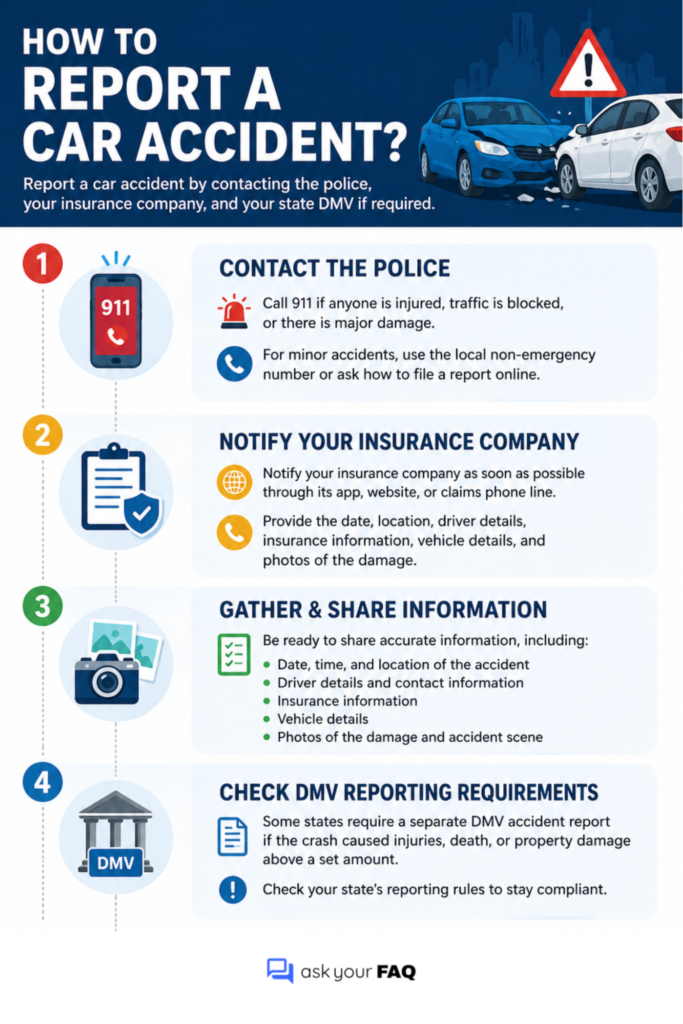
Report a car accident by contacting the police, your insurance company, and your state DMV if required.
Call 911 if anyone is injured, traffic is blocked, or there is major damage. For minor accidents, use the local non-emergency number or ask how to file a report online.
Notify your insurance company as soon as possible through its app, website, or claims phone line. Provide the date, location, driver details, insurance information, vehicle details, and photos of the damage.
Some states also require a separate DMV accident report if the crash caused injuries, death, or property damage above a set amount. Check your state’s reporting rules.
Police reports
4. Can you claim car accident without police report?
Yes, you can file a car accident claim without a police report, especially for minor accidents with no injuries. However, you’ll need strong evidence to support your claim.
- Collect photos or videos of vehicle damage, the accident scene, and road conditions. Exchange full contact, license, and insurance details with the other driver. Write down the date, time, location, and what happened, and gather witness information if available.
- Report the accident to your insurance company as soon as possible. Without a police report, insurers rely more on your documentation, which can make claims harder to verify in the event of a dispute.
- A police report is usually recommended for accidents involving injuries, significant damage, or disagreements about fault.
5. How to get a police report for a car accident?
Get the report number from the officer at the scene, then request the report from the responding agency (local police, sheriff, or state highway patrol).
You can usually request it:
- Online through the department’s website or a crash report portal
- In person or by mail from the records division
- Through your insurance company, which may obtain it for you
Reports are typically available within a few days to about 10 days. You’ll need details like the date, location, and names involved, and there may be a small fee depending on the agency.
Insurance claims & coverage
6. How to file a car accident claim?
To file a car accident claim, report the crash to your insurance company as soon as possible through its app, website, or claims phone number.
Before filing, collect the other driver’s name, contact details, license plate number, insurance information, and driver’s license details. Take photos of the damage, accident scene, road conditions, and any visible injuries.
If police responded, give your insurer the report number. Be factual when explaining what happened and avoid admitting fault.
After the claim is opened, an insurance adjuster may review the damage, estimate repair costs, and explain coverage for repairs, medical bills, or a rental car.
7. Whose insurance pays in a multi car accident?
In a multi-car accident, the insurance of the driver or drivers found at fault usually pays for the damages. If more than one driver shares blame, each insurer may pay based on that driver’s percentage of fault.
Your own coverage may also apply. Collision coverage can help pay for your car repairs, while PIP or medical payments coverage may help with medical bills, depending on your policy and state laws.
If the at-fault driver has no insurance or not enough coverage, uninsured or underinsured motorist coverage may help. Because fault can be disputed in multi-car crashes, a police report, photos, witness details, and dashcam footage can be important.
8. What happens if someone else is driving my car and gets in an accident?
If someone had permission to drive your car, your auto insurance usually applies first because coverage often follows the vehicle, not just the driver.
Your liability coverage may pay for damage or injuries caused to others. If you have collision coverage, it may help pay for repairs to your car after your deductible.
The driver’s own insurance may apply if damages exceed your policy limits. Coverage can be denied if the person was excluded from your policy, did not have permission, or lives in your household but is not listed on the policy.
Report the accident to your insurer and check your policy terms, since rules vary by state and insurance company.
9. How long will insurance pay for rental car after accident?
Insurance usually pays for a rental car during a reasonable repair period, up to the limits in the policy. Many rental reimbursement policies have a daily limit and a maximum number of days, often around 30 days.
If the other driver was at fault, their insurance may pay for a rental while your car is being repaired, as long as the time is considered reasonable.
If your car is totaled, rental coverage often ends shortly after the insurer makes a settlement offer or issues payment.
Check your policy for the daily amount, total limit, and covered rental period.
10. Who is responsible for rental car after accident?
The driver who caused the accident is usually responsible for rental car costs. If the other driver was at fault, their insurance may pay for a rental while your vehicle is being repaired.
If you caused the accident, your own insurance will only pay if you have rental reimbursement coverage. Without that coverage, you may have to pay out of pocket.
If fault is shared, rental costs may be divided based on each driver’s percentage of responsibility.
Rental coverage may have daily limits, total caps, or end once your vehicle is repaired or a total-loss settlement is offered.
Insurance rate increases/driving record
11. How much does car insurance go up after an accident?
Car insurance rates often increase after an at-fault accident, typically by about 20% to 50%, depending on the situation. Minor accidents may lead to smaller increases, while serious or costly claims can raise premiums significantly.
The exact increase depends on factors like fault, claim cost, your driving history, location, and your insurance company’s policies. Some insurers offer accident forgiveness, which may prevent a rate increase for a first incident.
The higher rate usually stays on your record for around three to five years before gradually decreasing.
12. How long does a car accident stay on your record?
A car accident typically stays on your driving record and affects insurance rates for about 3 to 5 years. Minor accidents may have a shorter impact, while more serious accidents can remain longer.
The timeline usually starts from the date of the accident. Insurance companies may review claims history for up to 5–7 years when determining premiums.
At-fault accidents tend to stay on record longer and have a greater impact on rates. More serious violations, such as DUI or reckless driving, can remain on your record for 10 years or more.
13. Why did my car insurance go up without an accident?
Your car insurance can go up without an accident because insurers also price policies based on risk, repair costs, and market conditions.
Common reasons include rising vehicle repair costs, higher medical costs, more claims in your area, theft or weather-related losses, traffic violations, credit score changes, added drivers, a new vehicle, or lost discounts.
Your premium may also increase if you change coverage limits, lower your deductible, move to a new ZIP code, or update your annual mileage.
Review your renewal notice, ask your insurer what changed, and compare quotes if the increase seems too high.
Lawyers / legal help
14. Should I get a lawyer for a car accident that wasn’t my fault?
You may want to hire a lawyer if you were injured, the insurance company disputes fault, or the settlement offer seems too low.
A lawyer can help handle negotiations, gather evidence, and work to recover costs such as medical bills, lost wages, and other damages, especially in more complex cases.
You may not need a lawyer for minor accidents with no injuries and clear liability, where the insurance process is straightforward.
If the accident involves serious injuries, multiple parties, or an uninsured driver, legal guidance can be more important.
15. Is it worth getting an attorney for a car accident?
It can be worth getting an attorney if the accident involves injuries, disputed fault, or a low settlement offer. A lawyer can handle negotiations, deal with insurance companies, and help recover compensation for medical bills, lost income, and other damages.
For minor accidents with no injuries and clear liability, you may be able to handle the claim on your own.
An attorney is more useful in complex cases, such as multi-vehicle accidents, uninsured drivers, or long-term medical issues.
16. What does a car accident lawyer do?
A car accident lawyer helps with the legal and insurance process after a crash. They can investigate the accident, collect evidence, review police reports, speak with witnesses, and help prove who was at fault.
They also deal with insurance companies, negotiate settlement offers, and estimate damages such as medical bills, lost wages, vehicle damage, and future care costs.
If the insurance company will not offer a fair settlement, the lawyer may file a lawsuit and represent you in court.
Lawsuits/Liability
17. I was a passenger in a car accident. Who do I sue?
As a passenger, you may have a claim against the driver who caused the accident. This could be the driver of the car you were in, another driver, or both if they share fault.
In most cases, you start by filing an insurance claim rather than immediately suing. The claim may seek compensation for medical bills, lost income, pain, and other accident-related losses.
Other parties may also be responsible in limited cases, such as an employer, vehicle manufacturer, or government agency. Time limits apply, so it is important to act promptly.
18. Can someone sue you for a car accident?
Yes, someone can sue you after a car accident, even if you have insurance. Most cases are handled through insurance claims, but a lawsuit may happen if there are serious injuries, disputed fault, or damages that exceed your policy limits.
If you are sued, your insurance company typically provides a lawyer and covers costs up to your coverage limits. You may be personally responsible for any amount beyond those limits.
Lawsuits are more common in cases involving major injuries, low settlement offers, or disagreements about who caused the accident.
19. How much can someone sue for a car accident?
There is no fixed limit; someone can sue for an amount based on the damages they claim. This can range from a few thousand dollars for minor injuries to much higher amounts in serious or long-term cases.
Compensation usually includes medical expenses, lost wages, vehicle damage, and non-economic losses like pain and suffering. In rare cases, additional damages may apply for reckless behavior.
The actual amount recovered often depends on factors like injury severity, fault, available evidence, and insurance policy limits.
Injury claims / medical bills
20. How long after a car accident can I claim injury?
You should report injuries and seek medical care as soon as possible, ideally within 24 to 72 hours. Some insurance policies and no-fault states have specific deadlines for medical treatment or notification.
For legal claims, the deadline is set by the statute of limitations, which is typically 1 to 3 years in many states, though it can be longer depending on location.
Waiting too long can affect your claim, especially if there is a delay in medical treatment or reporting. Always check your state’s rules and your insurance policy requirements.
21. How are medical bills paid after a car accident?
Medical bills after a car accident are often paid first through your own insurance, then addressed in the final settlement.
Depending on your policy and state, payment may come from PIP, MedPay, health insurance, or workers’ compensation if the crash happened while working. The at-fault driver’s insurer usually does not pay bills one by one while the claim is pending.
If insurance is not enough, some providers may treat you through a medical lien or letter of protection, meaning they are paid from a future settlement.
After settlement, insurers or medical providers may be reimbursed before you receive the remaining amount.
Settlements/Compensation
22. Why is my car accident settlement taking so long?
Car accident settlements can take months or longer because insurers and attorneys need time to evaluate the full value of the claim.
Common reasons for delays include ongoing medical treatment (waiting until your condition stabilizes), disputes over who was at fault, and back-and-forth negotiations with the insurance company. Cases involving multiple vehicles or serious injuries often take longer.
Delays can also come from gathering medical records, reviewing evidence, or court schedules if a lawsuit is filed.
In many cases, waiting ensures all medical costs and damages are fully accounted for before finalizing the settlement.
23. Are car accident settlements taxable?
Most car accident settlements are not taxable if they are for physical injuries or medical expenses.
Compensation for medical bills, physical pain, and injury-related suffering is generally tax-free. However, some parts of a settlement may be taxable.
Lost wages are usually taxable because they replace income. Punitive damages and any interest on the settlement are also taxable. Emotional distress may be taxable unless it is directly tied to a physical injury.
Tax treatment depends on how the settlement is structured, so it’s important to review the breakdown or consult a tax professional.
24. How to get more money from a car accident settlement?
To increase a car accident settlement, focus on strong documentation, consistent medical care, and careful negotiation.
Collect clear evidence such as photos, police reports, medical records, receipts, and witness details. Keep a record of your injuries, treatment, and how they affect daily life.
Follow all medical advice and avoid gaps in treatment, as insurers use this to reduce payouts. Do not accept the first settlement offer without reviewing the full value of your claim, including future medical costs and lost income.
Limit communication with insurers to factual details and avoid statements that could weaken your claim. In complex cases, legal guidance may help improve outcomes.
25. What is the average settlement for a car accident?
The average car accident settlement is often around $20,000 to $30,000 for injury claims, but the actual amount varies widely.
Minor injuries may settle for a few thousand dollars, while more serious injuries can reach six figures or higher. Severe or long-term cases can result in much larger payouts.
Settlement amounts depend on factors like medical expenses, lost income, injury severity, fault, insurance limits, and state laws. Because every case is different, averages are only a rough reference point.
Moving Forward
Car accidents can be stressful, especially when questions about insurance, liability, medical bills, and settlements come up all at once. This FAQ blog is designed to give simple, practical answers to the most common car accident concerns in one place.
By understanding what to do after a crash and how the claim process works, you can avoid mistakes and make more informed decisions.
Use this guide as a helpful starting point whenever you need quick clarity after a car accident.