
When people search for blood donation questions, they usually want simple, trustworthy answers before they decide to donate. Most queries are practical and concern-based, focused on what happens during donation, how long it takes, how much blood is taken, whether it hurts, what to eat, and how long recovery takes.
This blog content works best when answers are direct, reassuring, and easy to follow. Whether someone is preparing for their first donation, comparing whole blood and Power Red donations, or trying to understand recovery, the goal is to reduce fear, explain the process clearly, and help them feel ready before their appointment.
Summary
- Direct answers to common blood donation questions across donation types, preparation, needle size, pain, recovery, and aftercare
- Clear, practical explanations designed for first-time donors and regular donors who want quick guidance
- Covers whole blood donation, Power Red donation, double red cell donation, hemoglobin, food choices, hydration, and donation timelines
- Structured for easy scanning so readers can quickly understand what to expect before, during, and after donating
Donation Type Definitions
1. Who can donate blood?
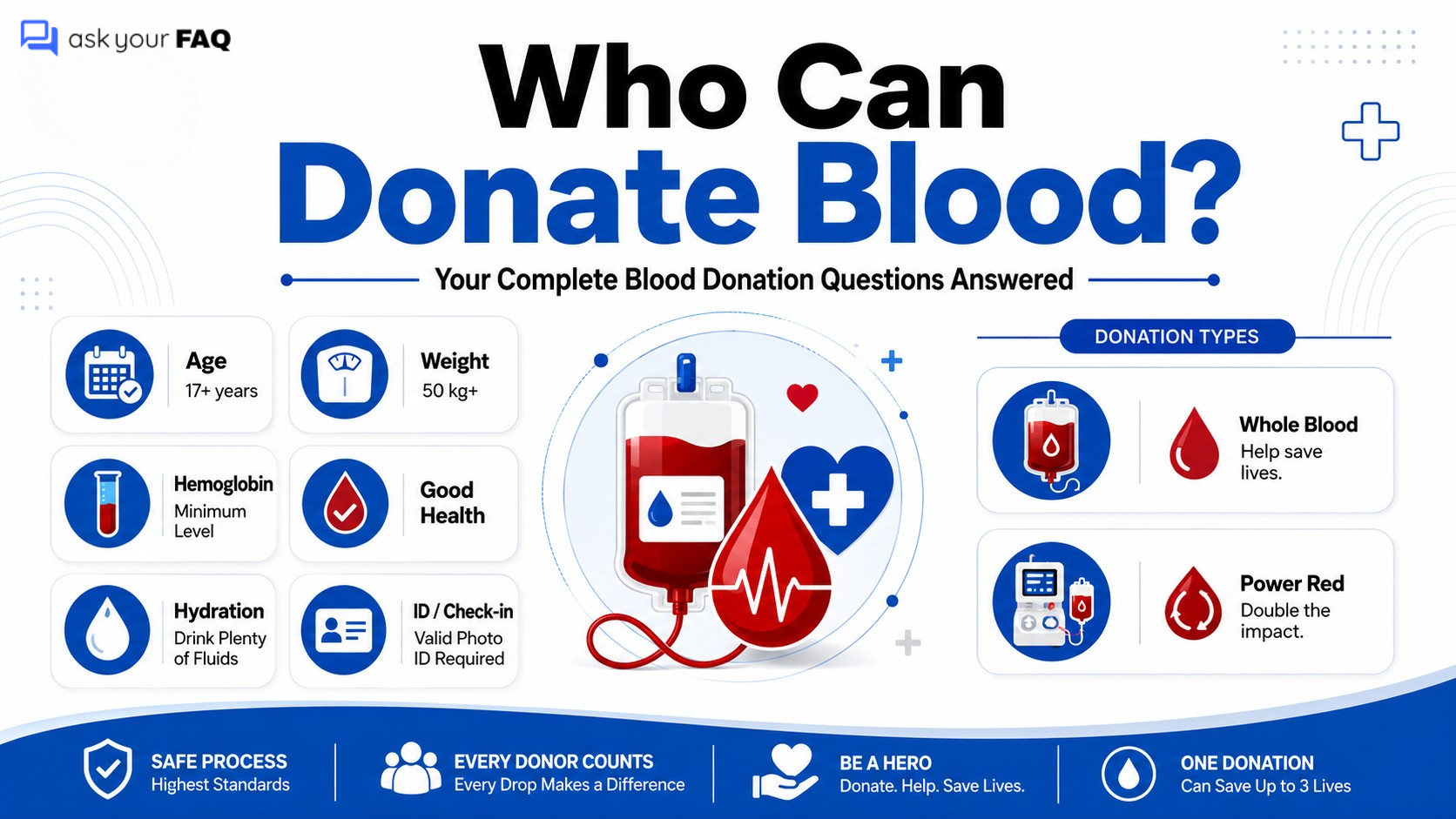
Most people can donate blood if they are in good general health, feel well on donation day, meet the minimum age requirement, and weigh at least 110 pounds. In many places, donors must be at least 17 years old, though 16-year-olds may be eligible with parental consent.
You must also pass a quick health screening, including checks for temperature, blood pressure, pulse, and hemoglobin level. Some medications, recent illness, travel, pregnancy, or medical conditions may affect eligibility, so check with your local blood donation center before your appointment.
2. What can disqualify you from donating blood?
You may be disqualified from donating blood if you have certain infections, medical conditions, low hemoglobin, recent illness, or recent high-risk exposure. Permanent disqualifiers may include HIV, hepatitis B or C, some blood cancers, or certain blood disorders.
Temporary deferrals can happen after a fever, cold, flu, antibiotics, pregnancy, recent tattoos or piercings, travel to malaria-risk areas, some medications, or a recent blood transfusion.
Many deferrals are temporary, so check with your local blood donation center for current eligibility rules before your appointment.
3. Can you donate blood if you take medication?
Yes, many people can donate blood while taking medication. In most cases, eligibility depends on why you take the medicine, whether your condition is stable, and whether you feel well on donation day.
Common medications such as blood pressure medicine, birth control, allergy medicine, vitamins, and many over-the-counter pain relievers usually do not prevent donation.
However, antibiotics for an active infection, some blood thinners, aspirin before platelet donation, and HIV prevention or treatment medications may require a waiting period or make you ineligible.
Never stop prescribed medication just to donate blood. Check with your donation center before your appointment.
4. Can you donate blood after being sick?
Yes, you can usually donate blood after being sick once you are fully recovered, feeling well, and meet all other eligibility requirements. Do not donate if you still have a fever, active infection, productive cough, sore throat, or flu-like symptoms.
For a cold or mild illness, many donors can give blood after being symptom-free for at least 24 to 48 hours, though some centers may require a longer wait. If you took antibiotics, wait until you finish the full course and feel healthy again.
For COVID-19, major illness, surgery, or travel-related infections, ask your local donation center about the correct waiting period.
5. Can you donate blood while pregnant or after pregnancy?
No, you cannot donate blood while pregnant because your body needs extra blood volume and iron to support pregnancy. In most cases, you may be able to donate whole blood at least 6 weeks after delivery or the end of pregnancy, as long as you feel well and meet all eligibility requirements.
If you are breastfeeding, ask your doctor or donation center when it is safe to donate, since iron and fluid needs may still be higher.
If you have been pregnant, some centers may require extra screening before platelet or plasma donation because of possible HLA antibodies.
6. What is a power red blood donation?
A Power Red donation is an automated blood donation where you give two units of red blood cells in one visit. It is also called a double red cell donation.
During the process, a machine separates your red blood cells and returns your plasma, platelets, and saline fluid to your body.
Power Red donations are especially helpful for patients who need red blood cells, such as trauma patients, surgery patients, newborns, and people with severe anemia.
This donation takes longer than a whole blood donation, usually about 1.5 hours total, and has stricter eligibility rules because it collects more red blood cells and iron.
7. What is whole blood donation?
A whole blood donation is the most common type of blood donation. Blood is collected from your arm into a donation bag, without being separated during the appointment.
Afterward, the donation is usually separated in a lab into red blood cells, plasma, and platelets, so one donation can help different patients.
A whole blood donation collects about 1 pint of blood. The blood draw usually takes 8 to 10 minutes, though the full visit takes longer because of check-in, screening, and recovery.
Most eligible donors can give whole blood every 56 days, depending on local rules and their health. All blood types are needed.
Donation Duration and Amount of Blood Taken
8. How long does blood donation take?
A standard whole blood donation takes about 1 hour total, but the actual blood draw is only 8 to 10 minutes.
Most of the visit is spent on check-in, health screening, and recovery. After donating, you’ll rest for 10 to 15 minutes with a drink and snack before leaving.
A double red cell donation, also called a Power Red donation, takes longer because a machine separates your blood and returns some components to you. It usually takes about 1.5 hours total, with the collection itself lasting around 20 to 30 minutes.
To save time, complete your health questionnaire online before your appointment if your donation center offers it.
9. How much blood is taken during donation?
The amount of blood taken depends on the donation type.
A whole blood donation collects about 1 pint, or roughly 500 mL. That is about 10% of the average adult’s blood volume.
A double red cell donation, also called a Power Red donation, collects two units of red blood cells. This is usually about 360 to 400 mL of concentrated red cells. The machine keeps the red blood cells and returns plasma and platelets back to your body.
So, whole blood removes more total fluid, while double red cell donation removes more red blood cells.
10. What hemoglobin level do you need to donate blood?
To donate blood, your hemoglobin must usually be at least 12.5 g/dL for women and 13.0 g/dL for men and nonbinary donors, though exact rules may vary by donation center and location. Hemoglobin is checked with a quick fingerstick before donation.
These minimum levels help make sure you have enough healthy red blood cells and do not become too tired or anemic after donating. If your hemoglobin is too low, you may be temporarily deferred.
Eating iron-rich foods like meat, fish, poultry, beans, lentils, spinach, and fortified cereal can help support healthy hemoglobin levels.
11. How much does hemoglobin drop after blood donation?
After a whole blood donation, hemoglobin usually drops by about 1.0 to 1.5 g/dL, or roughly 5% to 10%.
The drop may not show right away. In the first few hours, your hemoglobin reading can look similar because your blood has not been diluted yet. Over the next 24 to 48 hours, your body replaces lost fluid, which can make hemoglobin levels appear lower.
With a double red cell donation, the effect may last longer because more red blood cells are collected.
Hemoglobin usually takes 4 to 8 weeks to return to its normal level. Iron stores may take even longer, especially if your diet is low in iron.
12. How to increase hemoglobin for blood donation?
To increase hemoglobin before blood donation, focus on building your iron levels. Start about 2 to 3 weeks before your appointment.
Eat more iron-rich foods like beef, poultry, fish, beans, lentils, spinach, tofu, and iron-fortified cereals. Animal-based iron is easier for your body to absorb, but plant-based iron still helps.
Pair iron-rich foods with vitamin C foods like oranges, strawberries, tomatoes, bell peppers, kiwi, or broccoli to boost absorption.
Avoid coffee, tea, calcium-rich foods, and antacids close to iron-rich meals because they can block iron absorption.
On donation day, eat a balanced meal, drink plenty of water, and avoid greasy or fatty foods.
Preparing Before Donation
13. How to prepare for a blood donation?
To prepare for blood donation, focus on iron, hydration, rest, and the right meal.
In the days before your appointment, eat iron-rich foods like beef, poultry, beans, spinach, lentils, and fortified cereals. Add vitamin C foods such as oranges, strawberries, tomatoes, or bell peppers to help your body absorb iron.
The day before donating, drink extra water and get 7 to 8 hours of sleep. Avoid greasy or high-fat foods because they can affect blood testing.
On donation day, eat a healthy meal 2 to 3 hours before your appointment and keep drinking fluids. Wear sleeves that roll up easily, bring a valid ID or donor card, and complete any online health questionnaire ahead of time if available.
14. What to eat before blood donation?
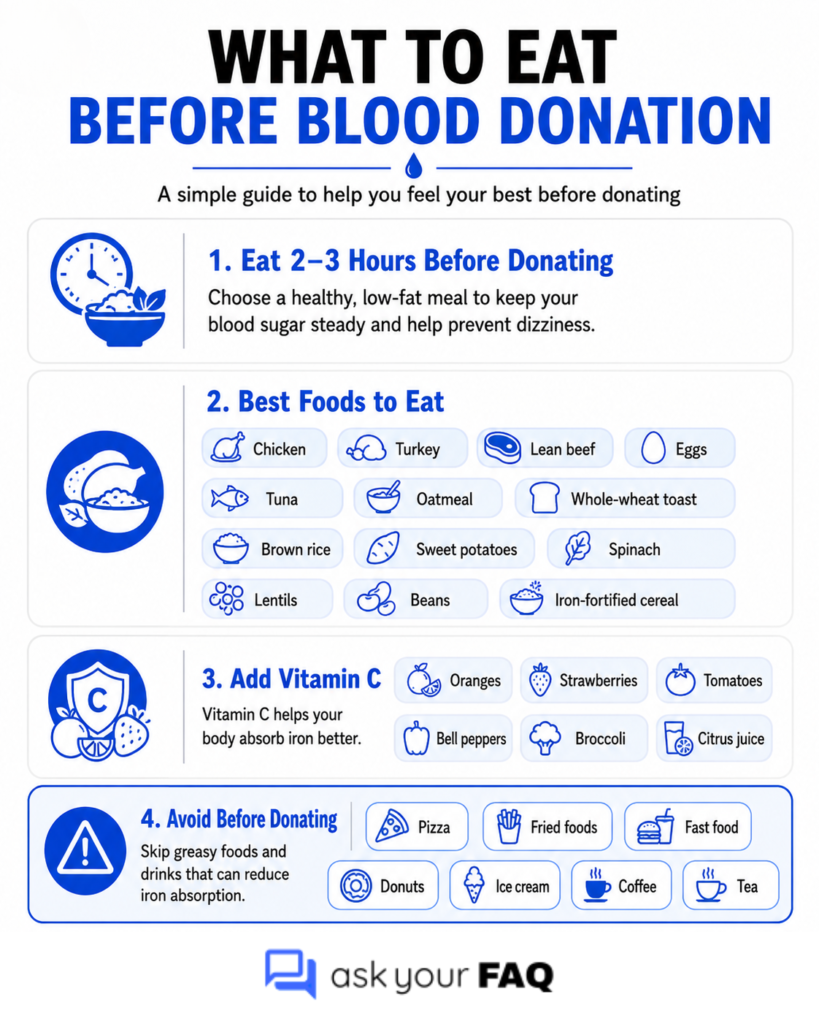
Eat a healthy, low-fat meal 2 to 3 hours before donating. This keeps your blood sugar steady and helps prevent dizziness.
Choose foods like chicken, turkey, lean beef, eggs, tuna, oatmeal, whole-wheat toast, brown rice, sweet potatoes, spinach, lentils, beans, or iron-fortified cereal.
Add vitamin C to help your body absorb iron better. Good options include oranges, strawberries, tomatoes, bell peppers, broccoli, or citrus juice.
Avoid greasy foods like pizza, fried foods, fast food, donuts, or ice cream before donating. Also, skip coffee and tea close to your meal, since they can reduce iron absorption.
Food and Drinks After Donation
15. What to eat after blood donation?
After blood donation, eat a snack right away and have an iron-rich meal later in the day.
Start with quick snacks like crackers, pretzels, fruit, cookies, a granola bar, juice, or water. These help raise your blood sugar and reduce dizziness.
For your next meal, choose foods that help your body rebuild red blood cells, such as lean beef, chicken, fish, eggs, lentils, beans, tofu, spinach, or iron-fortified cereal.
Pair iron-rich foods with vitamin C foods like oranges, tomatoes, strawberries, broccoli, or bell peppers to help your body absorb iron better.
Drink extra water for the rest of the day, and avoid alcohol until you feel fully recovered.
16. Which juice is good after blood donation?
The best juices after blood donation are orange juice, grapefruit juice, tomato juice, vegetable juice, pomegranate juice, and cranberry juice.
Orange and grapefruit juice help your body absorb iron better. They are rich in vitamin C. Tomato and vegetable juice help with hydration because they contain electrolytes like sodium and potassium.
Avoid sugary fruit cocktails or flavored drinks with little real juice. Juice is helpful, but water should still be your main drink after donating.
17. What to do after blood donation?
After donating blood, rest for 10 to 15 minutes, eat a snack, and drink water or juice before leaving. This helps prevent dizziness and gives your body a quick energy boost.
Keep your bandage on for several hours. For the rest of the day, avoid heavy lifting, intense exercise, alcohol, and too much heat, such as hot showers, saunas, or long sun exposure.
Drink extra fluids over the next 24 to 48 hours to help replace lost blood volume.
If you feel lightheaded, sit or lie down with your feet raised. If the needle site starts bleeding, raise your arm and press firmly with a clean cloth until it stops.
| Also Read: If you follow a regular training schedule, our Fitness FAQ: Goals, Workouts, Health, and Training Explained can help you plan around your donation days. |
18. How long to recover from blood donation?
Most people feel back to normal by the next day, but full recovery takes longer.
Your body replaces the lost plasma, or fluid part of blood, within 24 to 48 hours. Platelets and white blood cells usually recover within a few days.
Red blood cells take the longest. Hemoglobin and red blood cell levels may need 4 to 8 weeks to return to normal. Iron stores can take even longer, often 8 to 12 weeks or more.
After donating, drink extra fluids, avoid alcohol for the rest of the day, and skip heavy lifting or intense exercise for several hours. Most donors can return to normal activities as long as they feel well.
Donation Needle Size
19. What gauge or size needle is used for blood donation?
Blood donation usually uses a 16-gauge or 17-gauge needle, which is larger than the needle used for a routine blood test.
For whole blood donation, a 16-gauge needle is commonly used because it allows blood to flow quickly and smoothly into the collection bag. Automated donations, such as plasma, platelet, or double red cell donations, may use a 17-gauge or 18-gauge needle, depending on the equipment and donation center.
The needle is larger because donated blood needs to move smoothly without clotting or damaging red blood cells. Even though it may look big, most donors only feel a quick pinch when it goes in.
20. Does blood donation hurt?
Blood donation may feel like a quick pinch, but it should not be seriously painful.
You may feel two small stings: one from the finger prick used to check your hemoglobin, and one when the donation needle goes into your arm. After that, most donors feel little to no pain during the actual blood draw.
Mild pressure or awareness of the needle is normal. Sharp pain, burning, numbness, or pain moving down your arm is not normal, so tell the staff right away if that happens.
To make it easier, drink plenty of water, relax your arm, look away during the needle stick, and take slow, deep breaths.
Blood Storage and Shelf Life
21. How long is blood good for after donation?
Donated blood has a limited shelf life, and each blood component expires at a different rate.
Platelets last the shortest time, usually about 5 days. They are stored at room temperature and gently moved to prevent clotting.
- Red blood cells last about 35 to 42 days when refrigerated, depending on the preservative used.
- Whole blood can last about 21 to 35 days if it is stored without being separated.
- Plasma lasts the longest. Once frozen, it can usually be stored for up to 1 year.
Blood cannot be stored forever because the cells naturally break down over time. Once that happens, it may no longer be safe or useful for patients.
22. Do you get paid for blood donation?
No, you usually do not get paid for regular blood donation. Blood used for hospital transfusions is typically donated voluntarily through blood drives, hospitals, or nonprofit blood centers.
You may still get small thank-you rewards, such as snacks, T-shirts, gift cards, or donor points, but these are incentives, not payment for your blood.
The big exception is plasma donation. Private plasma centers may pay donors because plasma is often used to make medical therapies, not given directly as a standard blood transfusion.
So, if an ad says you can earn money by “donating blood,” it is usually talking about paid plasma donation, not whole blood or red blood cell donation.
23. How does blood donation work?
Blood donation is a quick, step-by-step process that usually takes about 1 hour, but the actual blood draw is only 8 to 10 minutes.
You’ll first check in, show your ID, and answer a few health questions. Staff will also check your pulse, blood pressure, temperature, and hemoglobin level to make sure you’re ready to donate.
Once approved, you’ll sit or lie back while a sterile needle is placed in your arm. About one pint of blood is collected, then your arm is bandaged.
Afterward, you’ll rest for 10 to 15 minutes with snacks and fluids. Your donated blood is then tested, typed, separated into useful components, and sent to hospitals for patients who need it.
Moving Forward
Blood donation can feel confusing at first, especially when questions about eligibility, needle size, donation types, hemoglobin, food, and recovery come up all at once. This FAQ blog is designed to give simple, practical answers to the most common blood donation concerns in one place.
By understanding what happens before, during, and after donation, you can feel more prepared, avoid common mistakes, and donate with more confidence.
Use this guide as a helpful starting point whenever you need quick clarity before giving blood.