

If you are here, chances are you are not looking for motivation or legal theory. You are trying to figure out what to do next and how to avoid mistakes that make an already difficult situation worse.
Divorce raises practical questions fast. When can I file? Where do I file? What documents will I need? How long will this take? What will it cost? Most people hit this stage before they ever speak to a lawyer.
This FAQ is meant to meet you at that point. It cuts through assumptions and gives direct answers to the questions people usually ask in private before taking formal legal steps.
This FAQ is meant to meet you at that point. It cuts through assumptions and gives direct answers to the questions people usually ask in private before taking formal legal steps—structured in a way similar to Yonyx Interactive Decision Trees to guide you step-by-step.
Whether you are thinking about filing, responding to papers, or preparing for a consultation, this guide is designed to help you understand the process, the rules, and the decisions that actually matter early on.
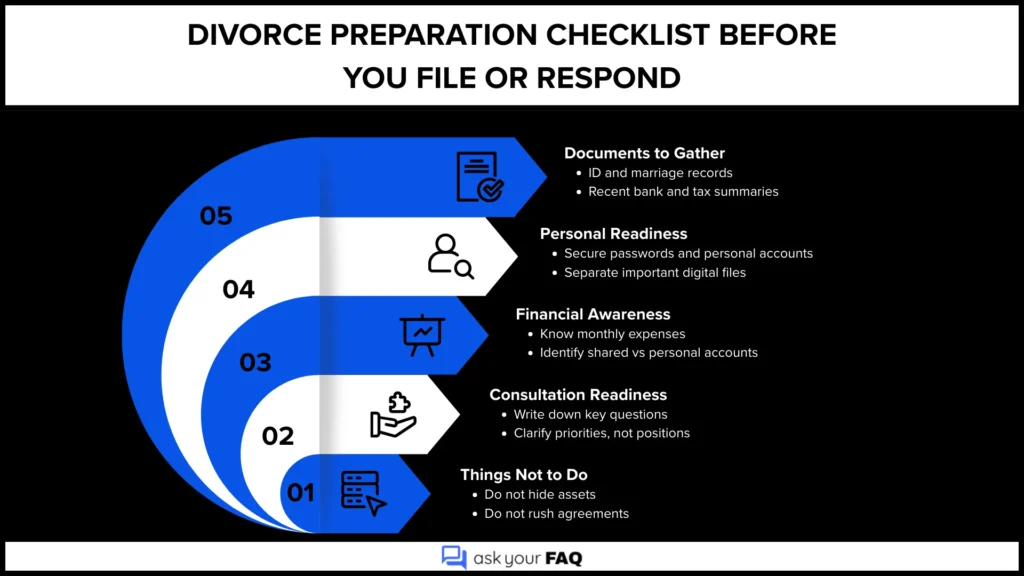
1. When can I file for divorce?
You can file for divorce once you meet your state’s legal requirements, which usually include residency and minimum waiting periods. Some states require one spouse to live in the state for a specific length of time before filing. There is generally no minimum marriage duration, although waiting periods may apply before the divorce becomes final.
2. Who can file for divorce? (Residency and jurisdiction requirements)
- At least one spouse must meet the state residency requirement
- The court must have jurisdiction over the marriage
- Filing usually occurs in the county where either spouse resides
- Rules vary by state and country
3. I have been married for only a few months. Can I still file for divorce?
Yes. Most jurisdictions do not require a minimum length of marriage to file for divorce. However, short marriages may impact property division, spousal support, and waiting periods. Some states impose a mandatory cooling-off period before finalizing the divorce.
4. What are the legal grounds for divorce?
- No-fault grounds such as irreconcilable differences
- Fault-based grounds in some jurisdictions, such as adultery or cruelty
- Mutual consent in jurisdictions that allow it
- Specific statutory grounds depending on local law
5. What is the difference between divorce, legal separation, and annulment?
- Divorce legally ends the marriage
- Legal separation allows spouses to live apart without ending the marriage
- Annulment declares the marriage legally invalid from the start
- Each option has different legal and financial consequences
6. What is a mutual consent divorce, and how does it work?
A mutual consent divorce occurs when both spouses agree to end the marriage and settle key issues such as property division, support, and custody. The process is usually faster, less expensive, and involves fewer court appearances than a contested divorce.
Filing and Initial Steps
7. How do I file for divorce?
- Prepare and file a divorce petition with the appropriate court
- Pay the filing fee or request a fee waiver if eligible
- Serve divorce papers on the other spouse
- File proof of service with the court
8. Where should I file for divorce if my spouse and I live in different locations or states?
Divorce is typically filed in the state where one spouse meets residency requirements. If spouses live in different states, jurisdiction depends on residency length, marital property location, and child-related issues. Consulting a lawyer is recommended in cross-state cases.
9. Can I file for divorce online or electronically?
Many courts allow electronic filing for divorce documents, especially in uncontested cases. Availability depends on the court and jurisdiction. Even when filing online, legal requirements such as service of process still apply.
10. Can I file for divorce on behalf of someone else?
No. Divorce has to be filed by one of the spouses. A friend, family member, or third party cannot start the process for them.
There are rare exceptions. If a spouse is legally incapacitated, a court-appointed guardian may be allowed to file, but only with court approval. This is not automatic and requires clear legal authority.
11. What documents do I need to file for divorce?
- Divorce petition or application
- Marriage certificate
- Financial disclosure forms
- Any required local court forms
- Filing fee receipt or waiver request
Serving Papers and Responding
12. How do I serve divorce papers once the case is filed?
- Personal service through a process server or sheriff
- Certified mail was permitted
- Substituted service if allowed by the court
- Service by publication in limited situations
13. I am having trouble serving divorce papers. What are my options?
If standard service methods fail, the court may allow alternative service such as publication or substituted service. You must usually show that reasonable efforts were made to locate the spouse.
14. I have been served with divorce papers. What should I do next?
- Review all documents carefully
- Note response deadlines
- File a formal response with the court
- Consider consulting a divorce attorney
15. Do I have to attend divorce hearings or court proceedings?
Attendance depends on whether the divorce is contested. Uncontested cases may not require appearances. Contested cases often require court hearings, especially for custody or property disputes.
Divorce Timeline, Cost, and Court Involvement
16. How long does the divorce process usually take?
Divorce timelines vary widely. Uncontested divorces may take a few months, while contested cases can last a year or longer, depending on court schedules and disputes.
17. Is divorce automatically finalized after a waiting period?
No. A waiting period only sets the earliest possible date for finalization. The court must still approve the divorce and issue a final judgment.
18. How much does a divorce typically cost?
- Court filing fees
- Attorney fees
- Mediation or expert costs
- Additional expenses in contested cases
19. Is it possible to get divorced without going to court?
In some cases, yes. If both spouses agree on all issues and the divorce is uncontested, many courts allow the process to move forward without in-person hearings. Documents are reviewed and approved by a judge without either party appearing in court.
That said, court involvement does not disappear. A judge must still review the paperwork and issue the final divorce order. If there are disputes over property, support, or children, a court appearance is usually required.
Financial Disclosure and Support
20. Do I have to disclose all of my finances during divorce?
Yes. In every divorce case, both parties are legally required to provide full and honest financial disclosure. This includes income, assets, debts, bank accounts, retirement funds, investments, and property.
The court relies on accurate information to divide marital assets fairly and determine support obligations. Attempting to hide assets, undervalue property, or provide incomplete information can lead to serious consequences, including court sanctions, monetary penalties, loss of credibility, and an unfavorable division of property.
21. Will I have to pay or receive spousal support (alimony)?
Spousal support, also known as alimony, is not automatic. Whether it is awarded depends on several factors, including the length of the marriage, each spouse’s income and earning capacity, age, health, and the standard of living established during the marriage.
Courts also consider contributions made to the household, such as staying home to raise children. The amount and duration of support vary by state and individual circumstances, and it may be temporary or long-term depending on the situation.
22. Can the court order one spouse to pay the other’s attorney fees?
Yes. Courts can order one spouse to contribute to the other’s attorney fees. This usually happens when there is a clear financial imbalance and one spouse would otherwise be unable to afford legal representation.
Attorney fees may also be ordered if one spouse causes unnecessary delays, hides information, or acts in bad faith during the divorce. The goal is fairness, not punishment.
Property, Assets, and Shared Benefits
23. How do courts divide property in a divorce?
Property division depends on the law in your jurisdiction. Some states follow community property rules, where marital assets are generally divided equally. Others apply equitable distribution, where the court divides property based on what is fair, not necessarily a fifty-fifty split. Factors such as marriage length, contributions, and financial circumstances are considered.
24. When can the court pass orders for the division of property?
Property division is usually decided during the divorce process and finalized in the final judgment. In certain situations, courts may issue temporary orders earlier to protect assets or address immediate financial concerns.
25. What happens to jointly used benefits such as memberships, reward points, or season tickets?
- Treated as marital property in many cases
- Divided by agreement or court order
- Some benefits may not be transferable
- Valuation may be required
26. I bought property with my own earnings, but it is registered in my spouse’s name. What happens in a divorce?
The name on the title does not automatically decide ownership. Courts look at when the property was purchased, where the money came from, and the intent behind putting it in your spouse’s name.
If it was bought during the marriage with marital income, it is usually considered marital property even if only your spouse’s name is listed. If you used separate funds (such as pre-marriage savings or inheritance) and can prove there was no intent to gift it, you may claim a separate interest. Documentation and financial records are crucial.
Name Change and Official Records
27. Can I change my name during or after a divorce?
Yes. Many courts allow name restoration as part of the divorce judgment. If not requested during divorce, a separate legal process may be required.
28. How do I get a copy or certified copy of my divorce decree or judgment?
- Contact the court clerk where the divorce was finalized
- Request copies in person, by mail, or online
- Pay applicable copy or certification fees
Special and Complex Situations
29. What if my spouse does not want to get divorced?
A divorce can usually proceed even if one spouse objects. Consent is not always required. When one party disagrees, the case becomes contested, which often increases time, cost, and court involvement.
30. Can I get a divorce if I do not know where my spouse is?
Yes. If you cannot locate your spouse, the court may allow alternative service, such as service by publication. You must first show that reasonable efforts were made to find them.
31. What happens if my spouse does not follow the divorce decree?
You can ask the court to enforce the order. This may involve contempt proceedings or other legal remedies to compel compliance or address violations.
32. Can a divorce judgment or court order be changed later?
Some parts can be changed. Orders related to support or custody may be modified if there is a significant change in circumstances. Property division is usually final and difficult to reopen.
33. Can I stop or pause a divorce once it has started?
Yes, in many cases, you can pause or stop a divorce, especially if both spouses agree. If the divorce has not been finalized, you may be able to file a request to dismiss the case. In some jurisdictions, couples can also ask the court for a temporary stay to allow time for reconciliation or settlement discussions.
However, if your spouse wants to proceed, you usually cannot permanently stop the divorce. Courts generally allow one spouse to move forward even without the other’s consent.
Religion, Cross-Border, and Status-Based Questions
34. How does divorce work for interfaith or religious marriages?
Divorce is governed by civil law, not religious law. Courts apply the same legal standards regardless of the religion or faith involved. Any religious or cultural divorce practices are separate and do not replace the legal divorce process.
35. I am married to an NRI, or my spouse lives abroad. Where can I file for divorce?
Where you can file depends on residency, citizenship, and which country’s courts have legal jurisdiction over the marriage. Some cases can be filed where you live, while others may need to be filed where the marriage took place or where your spouse resides. Cross-border divorces are complex and usually require legal advice to avoid jurisdiction conflicts.
36. Can I remarry before my divorce is finalized?
No. You must wait until the court issues a final divorce decree. Remarrying before that point can lead to serious legal issues, including the new marriage being legally invalid.
Consultation and Next-Step Guidance
37. Who should file first in a divorce, and does it matter?
Filing first does not decide who “wins” the divorce. It does, however, come with some procedural advantages. The person who files controls the timing, chooses the initial court location if more than one option exists, and sets the pace at the start of the case.
Whether filing first makes sense depends on your situation. In some cases, waiting allows more time to prepare financially or gather documents. In others, filing first can prevent delays or jurisdiction issues. The right approach is strategic, not automatic.
38. What questions should I ask during my first divorce consultation?
- Expected timeline
- Legal costs
- Likely outcomes
- Required documents
- Next steps
39. What information should I prepare before meeting a divorce lawyer?
- Marriage details
- Financial records
- Property information
- Child-related details
- Prior court orders
40. When should I seek legal advice instead of handling my divorce on my own?
You should seek legal advice when the divorce is not straightforward. If there are disagreements, significant assets, children involved, or questions about jurisdiction, handling the process alone can create long-term legal and financial risks.
Legal guidance is also important if your spouse has a lawyer, if you feel pressured to agree to terms, or if you are unsure about your rights and obligations. In these situations, professional advice is less about escalation and more about protecting your position early.
Related Reads
Law Firm FAQ: How Firms Operate, Communicate, and Manage Cases
Home Equity Loan FAQ: Understanding Eligibility, Rates, and Requirements