
Search engine optimization raises many practical questions, even among experienced marketers and site owners. From technical audits and keyword strategy to link signals and reporting, SEO involves multiple moving parts that influence how websites perform in search results.
As search algorithms evolve and AI-driven results become more common, understanding how each element contributes to visibility becomes increasingly important. This blog answers common SEO questions to clarify how these components work together in modern search.
As search algorithms evolve and AI-driven results become more common, understanding how each element contributes to visibility becomes increasingly important. This blog answers common SEO questions to clarify how these components work together in modern search—structured in a way similar to Yonyx Interactive Decision Trees to help break down complex topics step-by-step.
Summary
- Clear explanations of essential SEO concepts, terminology, and processes commonly used in search engine optimization
- Coverage of key SEO strategies, including keyword research, technical optimization, content creation, and link building
- Insights into SEO roles, services, and industry practices, such as SEO consultants, managers, agencies, and campaigns
- Practical guidance on improving search visibility, measuring performance, and understanding factors that influence website rankings
SEO Basics & Core Concepts
1. What is an SEO company?
An SEO company is a service provider that improves a business’s visibility in search engines to increase organic traffic, leads, and sales. It applies optimization strategies across content, technical setup, and backlinks to help websites rank higher in search results.
Services commonly provided by an SEO company include:
- Performing technical SEO audits to identify site issues
- Conducting keyword research and optimizing website content
- Developing content marketing strategies for search visibility
- Building quality backlinks to strengthen domain authority
- Managing local SEO and improving business listings
2. What is seo consulting?
An SEO consultant advises businesses on how to improve their website’s performance in search engines. They analyze existing SEO issues and create strategies that increase organic visibility, traffic, and lead generation.
3. What is white hat and black hat seo?
White hat and black hat SEO describe two different approaches to search engine optimization. White hat SEO follows search engine guidelines and focuses on sustainable growth, while black hat SEO uses manipulative tactics to gain quick rankings.
Such SEO practices include:
- Creating high-quality, relevant content for users
- Performing proper keyword research and on-page optimization
- Improving website speed, mobile usability, and user experience
- Building natural backlinks from reputable websites
Black hat SEO techniques include:
- Keyword stuffing and hidden text
- Cloaking or showing different content to search engines and users
- Using spammy link schemes or automated backlinks
- Manipulating rankings in ways that violate search engine guidelines
4. What is cloaking in seo?
Cloaking in SEO is a deceptive technique where a website shows one version of a page to search engines and a different version to users. It is used to manipulate rankings by displaying keyword-optimized content to search engine bots while visitors see different or unrelated content.
Key points about cloaking:
- It is a black hat SEO practice that violates search engine guidelines
- It often uses IP or user-agent detection to show different content to bots and users
- Websites caught using cloaking can face ranking penalties or removal from search results
5. What is seo writing
SEO writing is the process of creating content that ranks well on search engines while remaining useful for readers. It involves keyword optimization, clear content structure, relevant metadata, internal linking, and addressing search intent to increase website visibility and organic traffic.
6. What is meta data seo?
Metadata in SEO refers to HTML tags such as meta titles and meta descriptions that describe a webpage to search engines and users. These tags help search engines understand page relevance and influence how the page appears in search results.
7. What is LSI keyword in seo?
LSI keywords are semantically related terms that help search engines understand the context of content. They improve relevance and reduce keyword stuffing by naturally including related words that commonly appear with the main keyword.
8. What is an seo audit?
An SEO audit is a detailed analysis of a website to identify issues that affect search engine rankings and organic traffic. It evaluates the site’s overall SEO health and highlights areas that need improvement.
Key Elements:
- Technical SEO: Checking crawlability, indexability, site speed, mobile-friendliness, and security
- On-page SEO: Reviewing content quality, keyword usage, meta tags, and internal linking
- Off-page SEO: Analyzing the backlink profile to identify strong and harmful links
9. What are seo citations?
In SEO, a citation is an online mention of a business’s name, address, and phone number (NAP) on websites such as directories, review platforms, or social media. Citations help search engines verify business legitimacy and improve local search visibility.
Types:
- Structured citations: Listings on platforms like directories and business profiles
- Unstructured citations: Mentions on blogs, news sites, or social media
10. What is seo copywriting?
SEO copywriting is the process of writing content that ranks well in search engines while encouraging readers to take action. It combines search intent analysis, keyword research, and persuasive writing to attract targeted organic traffic.
11. What is meta keywords in seo?
Meta keywords are an outdated HTML meta tag once used to list keywords that describe a webpage’s content. Search engines like Google no longer use them for rankings because they were widely abused for keyword stuffing.
12. What is enterprise seo?
Enterprise SEO refers to search engine optimization strategies designed for very large websites that contain thousands or even millions of pages. It focuses on managing complex site structures, improving visibility for competitive keywords, and maintaining consistent optimization across large volumes of content.
13. What is keyword difficulty in seo?
Keyword difficulty (KD) is an SEO metric that estimates how difficult it is to rank on the first page of search results for a specific keyword. It usually ranges from 0 to 100 and reflects the level of competition.
- Strength and number of backlinks pointing to top-ranking pages
- Authority and reputation of competing websites
- Content relevance and quality already rank in search results
14. What is an seo campaign?
An SEO campaign is a planned series of SEO activities carried out over a specific period to improve a website’s rankings, traffic, and visibility for targeted search queries. It focuses on clear goals such as promoting certain pages or keywords.
Activities commonly included in an SEO campaign:
- Keyword research to identify valuable search terms
- On-page optimization of content and HTML elements
- Technical improvements, such as site speed and crawlability
- Link building to strengthen domain authority
- Monitoring results to measure traffic and ranking improvements
15. What is bounce rate in seo?
Bounce rate in SEO is the percentage of visitors who leave a website after viewing only one page without interacting further. It helps indicate whether the page content meets user expectations and engages visitors.
Situations that often lead to a high bounce rate include:
- Slow page loading speed
- Content that does not match the user’s search query
- Poor mobile optimization or difficult navigation
- Weak user experience or intrusive design elements
16. What is seo landing page?
An SEO landing page is a dedicated webpage created to rank in search engines for specific keywords and convert organic visitors into leads or customers. It focuses on a targeted search query and guides users toward one clear action.
SEO Strategy, Execution & Optimization
17. How to use keywords for seo?
Using SEO keywords effectively means placing relevant search terms in key parts of your content so search engines can understand the topic and match it with user queries. Keywords should be used naturally and aligned with search intent.
Effective keyword placement typically includes:
- Adding the primary keyword in the title tag, URL, and H1 heading
- Using related keywords in subheadings and throughout the content
- Including the keyword early in the introduction
- Optimizing image alt text and meta descriptions
- Using long-tail variations to target more specific searches
18. How to add seo keywords in HTML?
To add SEO keywords in HTML, place them in important elements such as the title tag, meta description, H1 heading, and relevant H2 or H3 headings. Keywords should also appear naturally in the page content, image alt text, and URL, while avoiding the outdated meta keywords tag, since search engines no longer use it.
19. How to boost seo?
Improving SEO involves optimizing content, website structure, and authority signals so search engines can better understand and rank your pages.
Common ways to improve SEO include:
- Conducting keyword research to target relevant search queries
- Creating valuable, well-structured content that answers user questions
- Optimizing on-page elements such as titles, meta descriptions, and headings
- Improving site speed, mobile responsiveness, and technical performance
- Building high-quality backlinks from reputable websites
- Monitoring performance through tools like Google Search Console and analytics
20. How to improve wordpress seo?
Improving WordPress SEO involves optimizing your site’s structure, content, and performance so search engines can crawl and rank pages more effectively.
Useful steps to improve WordPress SEO include:
- Installing an SEO plugin such as Yoast SEO or Rank Math to manage meta tags and sitemaps
- Setting clean permalinks using the “post name” structure
- Creating keyword-focused, high-quality content with proper headings
- Compressing images and using caching to improve site speed
- Submitting XML sitemaps to Google Search Console and monitoring performance
21. How many seo keywords should I use?
For SEO, it is best to focus on one primary keyword per page and include a few related or secondary keywords that support the main topic. The goal is to use them naturally so the content remains readable and relevant.
22. How important are keywords in seo?
Keywords are essential in SEO because they connect user search queries with relevant website content. They signal to search engines what a page is about and help determine when it should appear in search results.
- Helping search engines understand the topic and relevance of a webpage
- Matching content with the search intent of users
- Increasing visibility and organic traffic through targeted search terms
- Guiding content planning and website optimization strategies
Technical SEO & Performance
23. How to conduct a technical seo site audit?
Conducting a technical SEO audit involves examining a website’s technical setup to ensure search engines can crawl, index, and understand its pages properly.
A typical audit process includes:
- Crawling the website to detect errors such as broken links and redirect issues
- Reviewing crawlability through robots.txt, XML sitemaps, and indexing status
- Checking HTTPS security and identifying mixed content problems
- Evaluating page speed and Core Web Vitals performance
- Testing mobile usability and responsive design
- Identifying duplicate content and verifying proper canonical tags
24. How many internal links per page seo?
There is no fixed number of internal links required for SEO. The ideal amount depends on the length and purpose of the content, but links should always be relevant and useful for readers.
General internal linking guidelines include:
- Short pages may include around 2 to 5 internal links
- Longer articles can naturally include 7 to 10 or more links
- Links should connect related pages to improve navigation and site structure
- Use clear anchor text so search engines understand the relationship between pages
25. Does page speed affect seo?
Yes, page speed affects SEO because search engines consider website performance when ranking pages. Faster sites provide a better user experience and allow search engines to crawl and index pages more efficiently.
Ways page speed influences SEO include:
- Improving user experience by reducing waiting time
- Lowering bounce rates when pages load quickly
- Helping search engines crawl more pages efficiently
- Supporting performance metrics such as Core Web Vitals
Link Building & Off-Page SEO
26. What is article submission in seo?
Article submission in SEO is an off-page practice where original articles are published on third-party websites to gain backlinks and increase website visibility.
- Writing informative, original articles on relevant topics
- Publishing them on reputable blogs or content platforms
- Adding natural backlinks within the article or author bio
- Prioritizing quality platforms over low-value article directories
27. Do nofollow links help seo?
Yes, nofollow links can support SEO even though they do not pass traditional ranking authority like follow links. Search engines treat them as signals that may still provide value in certain contexts.
28. Are external links good for seo?
Outbound links can support SEO indirectly by linking to relevant, authoritative websites. They provide additional context for search engines and show that your content references credible sources.
Benefits of using outbound links include:
- Strengthening credibility by referencing trusted sources
- Helping search engines understand the topic and context of your content
- Improving user experience by guiding readers to useful information
- Supporting stronger content quality and topical authority
Measurement, Reporting & Analytics
29. How to create seo report?
Creating an SEO report involves collecting performance data and presenting insights that show how search optimization efforts impact traffic and business results.
A typical process for preparing an SEO report includes:
- Gathering data from tools such as Google Analytics, Google Search Console, and SEO platforms
- Tracking metrics like organic traffic, keyword rankings, conversions, and backlinks
- Summarizing key findings and performance changes over time
- Explaining what caused improvements or declines in results
- Outlining clear recommendations and next actions for future optimization
30. What is seo report?
An SEO report is a summary that shows how a website performs in search engines and how SEO efforts impact traffic and visibility. It presents performance data and insights that help track progress and support future optimization decisions.
An SEO report usually covers:
- Changes in organic traffic and user activity from search engines
- Keyword ranking movements in search results
- Technical performance, such as indexing issues, site speed, and mobile usability
- Backlink growth and link quality analysis
- Practical recommendations to improve rankings and search performance
SEO Careers, Roles & Industry
31. How to be an seo expert?
To become an SEO specialist, learn how search engines work and develop skills in keyword research, content optimization, technical SEO, and link building. Practical experience and familiarity with industry tools are essential.
32. Steps commonly followed to enter the field include:
- Studying SEO fundamentals and taking recognized online courses
- Practicing by building and optimizing your own website
- Learning tools such as Google Analytics, Google Search Console, SEMrush, and Ahrefs
- Understanding basic HTML and website structure
- Gaining real experience through freelance projects or entry-level roles
33. What is an seo consultant?
An SEO consultant analyzes websites and develops strategies to improve search rankings, organic traffic, and online visibility.
Common responsibilities include:
- Conducting website audits to identify SEO issues
- Performing keyword research and competitor analysis
- Improving technical SEO, such as site speed and crawlability
- Optimizing content to align with search intent
- Developing link building strategies to strengthen domain authority
34. What is an seo manager?
An SEO manager oversees a company’s search engine optimization efforts to improve organic traffic and search visibility. The role includes planning strategy, coordinating optimization work, and monitoring performance.
Core responsibilities:
- Planning and managing SEO strategies aligned with business goals
- Conducting keyword research and guiding content optimization
- Collaborating with developers to improve technical SEO and site structure
- Managing on-page optimization and backlink efforts
- Monitoring rankings, traffic, and conversions using analytics tools
Client Acquisition, Leads & Business Growth
35. How to get seo clients?
Getting SEO clients involves combining authority building with proactive outreach to businesses that need search visibility improvements.
Common ways professionals attract SEO clients include:
- Offering a free SEO audit to highlight opportunities and issues on a prospect’s website
- Reaching out through LinkedIn or email to business owners and marketing leaders
- Publishing content or case studies that demonstrate SEO expertise
- Specializing in a specific industry to build credibility and referrals
- Networking with web developers, agencies, or business groups for partnership opportunities
36. How to generate seo leads?
Generating SEO leads involves attracting potential customers through organic search by targeting relevant queries and guiding visitors toward a clear action on the website.
Effective ways to generate SEO leads include:
- Targeting high-intent keywords that indicate users are ready to take action
- Creating helpful content such as guides, blog posts, and case studies
- Optimizing landing pages with clear calls-to-action
- Improving site performance and mobile usability
- Using local SEO and business listings to capture location-based searches
Hiring & Choosing SEO Services
37. What are the questions to ask when hiring an seo company?
When hiring an SEO company, it is important to ask questions that reveal their strategy, experience, and transparency. The goal is to ensure they follow ethical practices and can deliver measurable results.
Useful questions to ask include:
- What SEO strategies do you use for on-page, technical, and off-page optimization?
- Can you share case studies or examples of successful campaigns?
- How do you approach link building and avoid risky practices?
- What metrics do you use to measure SEO success?
- How often will you provide reports and updates?
38. How to choose the right seo company?
Choosing the right SEO company requires evaluating their experience, transparency, and strategy to ensure they can deliver long-term results.
Important factors to consider include:
- Defining your goals, budget, and success metrics before hiring
- Reviewing the agency’s portfolio, case studies, and client reviews
- Understanding their SEO process, including technical, on-page, and link-building strategies
- Ensuring they provide regular reporting and clear communication
- Avoiding companies that guarantee rankings or use vague, secret methods
SEO Costs, Value & ROI
39. How much to spend on seo?
How much to spend on SEO depends on business size, competition, and growth goals. Many small businesses invest between $500 and $2,000 per month, while mid-sized companies often spend $1,500 to $5,000 or more for broader strategies.
Typical SEO pricing structures include:
- Monthly retainers for ongoing optimization work
- Hourly consulting rates for specific tasks or guidance
- Project-based pricing for audits or website optimization
- Local SEO packages for location-focused businesses
40. Is seo worth it?
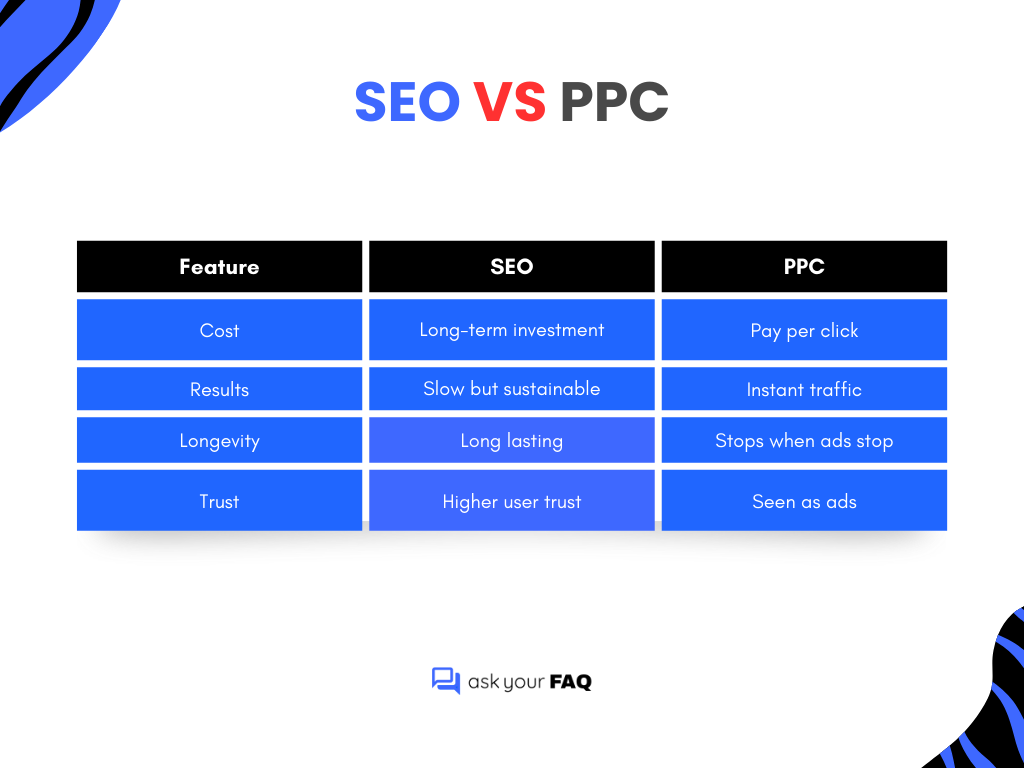
Yes, SEO is generally worth the investment because it drives consistent organic traffic and builds long-term online visibility. Unlike paid advertising, SEO continues to generate results even after the initial optimization work.
Reasons many businesses invest in SEO include:
- Generating sustainable organic traffic over time
- Building credibility by appearing in top search results
- Attracting users actively searching for products or services
- Delivering long-term marketing value compared to paid campaigns
41. How long does seo take to work?
SEO usually takes 4 to 12 months to deliver noticeable results. Early improvements, such as indexing or minor ranking changes, may appear within a few weeks, but consistent traffic growth typically begins after several months.
The timeline depends on several factors:
- The age and authority of the website
- Competition for the targeted keywords
- Existing technical issues or penalties
- Consistency in publishing quality content and building backlinks
Advanced SEO Features & SERP Enhancements
42. Do rich snippets help seo?
Rich snippets can support SEO by enhancing how a webpage appears in search results. They use structured data to display extra information such as ratings, prices, or FAQs, which makes listings more noticeable.
Advantages of rich snippets:
- Improving click-through rates by making search results more visually appealing
- Increasing visibility by occupying more space in search results
- Providing users with quick information before they click
- Helping search engines better understand the content through structured data
43. Is seo dead?
SEO is not dead. It has evolved as search engines now prioritize user experience, content authority, and search intent instead of simple keyword optimization.
Modern SEO focuses on:
- Creating high-quality content that demonstrates expertise and trust
- Optimizing content to answer user queries clearly
- Adapting to AI-driven search features and evolving algorithms
- Expanding visibility across platforms such as search, video, and social media
44. Why unique content so important in seo?
Unique content is important for SEO because search engines prioritize original information that provides value to users. It improves visibility in search results and prevents issues related to duplicate or copied content.
Reasons unique content supports SEO include:
- Helping pages rank higher by offering original and relevant information
- Avoiding duplicate content issues that can reduce rankings
- Increasing user engagement and time spent on the page
- Building credibility and encouraging other websites to link to your content
Bringing Together the Key Elements of SEO
Search engine optimization requires a clear understanding of strategy, technical structure, and content relevance. The questions covered in this guide clarify key SEO concepts, roles, and practices that influence search performance. As search technologies and algorithms evolve, understanding these fundamentals supports more informed decisions about optimization and website visibility.