
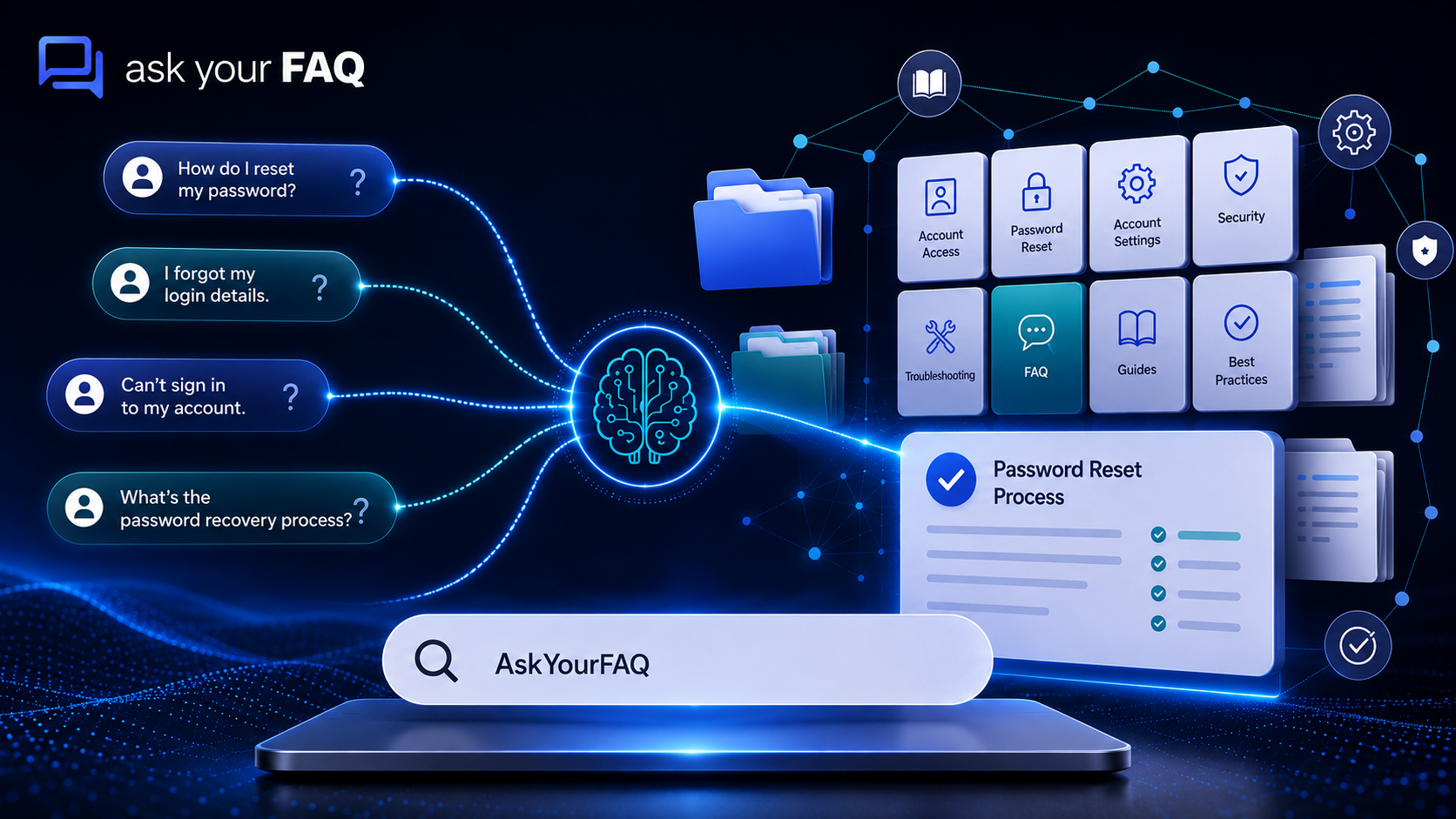
Intent based search is changing how people find answers inside FAQ pages, help centers, and internal knowledge bases. Instead of matching the exact words a person types, it interprets what they actually mean, so the right answer comes back even when the wording never matches the source content.
This guide explains what intent based search is, how it works under the hood, how it compares to keyword and semantic search, and how to bring it into your own knowledge base or FAQ.
Strategic & Definitional Foundations
1. What is intent based search, in plain terms?
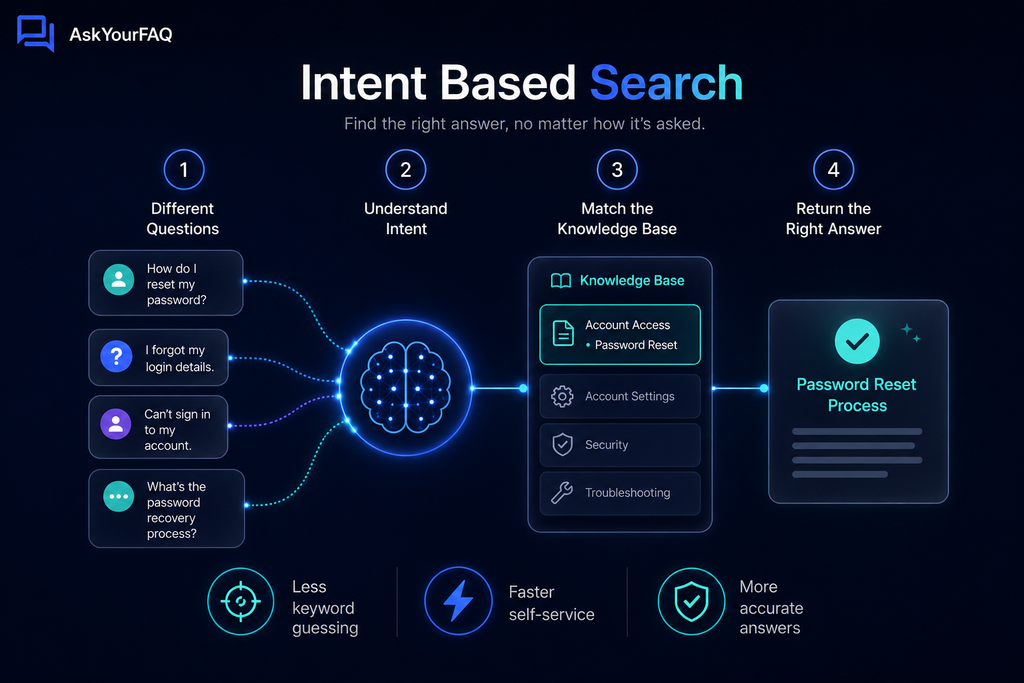
Intent based search retrieves answers based on what users mean, not the exact words they type. For example, “I forgot my login” can match “How do I reset my password?” because both share the same intent. This powers AI-powered FAQ search bars and modern AI knowledge bases.
2. Why should a knowledge base move away from keyword search?
Keyword search depends on exact word matches, but users often describe problems differently from the documentation. Intent based search solves this by matching meaning instead, helping more visitors find answers through self-service and reducing unnecessary support tickets.
3. Is intent based search the same thing as “search intent” in SEO?
No, but they’re related. Search intent is an SEO concept that describes a user’s goal, such as informational or transactional. Intent based search is the technology that detects this goal in real time and retrieves the most relevant answer from a search bar or knowledge base.
4. What business problem does intent based search actually solve?
Intent based search solves the gap between how customers describe problems and how documentation is written. For example, “charged twice” can match an article titled “Duplicate Transaction Dispute Process.” It recognizes the shared meaning without requiring every possible phrase to appear in the content.
5. Which teams see the fastest return from adding intent based search to a knowledge base?
Customer support usually sees the fastest return, often within the first 30 to 60 days, because repetitive, high-volume questions get deflected before they become tickets. Internal IT and HR help desks are typically next, since employees stop escalating simple policy or access questions to a live person.
How Intent Based Search Works
6. How does intent based search actually work, step by step?
It generally works in three stages: natural language understanding classifies what the visitor is asking, semantic matching compares that meaning against the approved content, and the system returns the closest grounded answer. None of these steps depend on the visitor phrasing the question the way the content author originally wrote it.
7. What is the difference between intent based search and semantic search?
Semantic search matches content by conceptual meaning, often using vector embeddings. Intent based search goes further by identifying the user’s specific goal, such as “reset password” or “check order status.” In many FAQ tools, semantic search handles matching, while intent classification determines what the user wants.
8. What role do embeddings play in this kind of search?
Embeddings convert words and sentences into numerical values that represent their meaning, so a system can measure how close two phrases are even if they share no words in common. This is the mechanism that allows “I can’t log in” and “reset my password” to be recognized as related, which keyword matching alone cannot do.
9. Why do intent based search platforms rely on a vector database?
A vector database stores content as embeddings and is built specifically to find the closest match by meaning rather than exact text, which makes it far faster than scanning every document for keyword overlap. Many platforms also apply metadata filters on top, so results can be limited to a specific FAQ category, language, or user permission level.
10. What is retrieval-augmented generation, and how does it relate to intent based search?
Retrieval-Augmented Generation (RAG) is a technique where an AI system first retrieves the most relevant approved content for a question, then uses that content to generate the final answer instead of relying on general knowledge. Intent based search is typically the retrieval half of that pipeline, finding the right source material so the generated response stays grounded in what the business has actually approved.
11. How does the system decide it has correctly understood a question?
Most platforms assign a confidence score to each potential match based on how closely the question’s meaning aligns with existing content. When confidence is high, the answer is returned directly; when it’s low, a well-built system asks a clarifying question or flags the query for a human instead of guessing.
Accuracy, Reliability & Content Fit
12. Can intent based search give a wrong answer if the underlying content is thin?
Yes. Accuracy depends heavily on how clean, current, and specific the source FAQ content is, since the system can only match against what it has been given. Outdated, duplicate, or vaguely worded articles are the most common cause of incorrect or overly generic answers, regardless of how advanced the matching model is.
13. What happens when a visitor asks something the FAQ database doesn’t cover?
A well-designed system doesn’t force a guessed answer. Instead, it flags the query as unresolved, and, in most platforms, it automatically notifies the content owner with the exact question so it can be added and instantly answered for future visitors.
14. How many FAQ entries does a business actually need before intent based search performs well?
It doesn’t need to be large to work. Even 5 to 10 clear, well-written Q&A pairs can be enough to launch, and the platform can expand from there based on real questions it receives. A small set of accurate, current answers consistently outperforms a large FAQ page full of outdated or overlapping entries.
15. How does intent based search handle two FAQ entries that seem to conflict?
The safest approach is for the system to prioritize the most recently updated or explicitly approved entry rather than blending both answers together. Clear “last updated” dates, version notes, and a single content owner per topic make it much easier for the matching engine to resolve this correctly instead of surfacing contradictory information.
16. How is intent based search kept from hallucinating an answer that isn’t in the FAQ?
Reliable systems are explicitly grounded, meaning they are instructed to answer only from the approved FAQ database rather than generating an open-ended response from general AI knowledge. Combined with confidence scoring and human escalation for low-confidence matches, this keeps the system from fabricating a plausible-sounding but incorrect answer.
Implementation & Choosing a Solution
17. Do you need developers to add intent-based search to an existing FAQ page?
For most FAQ-focused platforms, no. Tools like AskYourFAQ let a non-technical content owner add Q&A pairs from a dashboard and publish an embeddable AI search bar with a copy-paste script, without rebuilding the site or hiring engineering resources.
18. How long does it take to go from zero to a working intent based search bar?
Most small to mid-size FAQ implementations can go live within a day once the initial 5 to 10 Q&A pairs are entered, since the search bar is generated automatically from that content. Larger implementations that connect multiple internal data sources, such as Slack, Confluence, or a CRM, typically take longer due to access and permission setup.
19. What should a business evaluate before choosing an intent based search vendor?
Test vendors with real customer phrasing, including typos, slang, and incomplete questions. Check whether answers stay grounded in approved content, how the system handles unanswered queries, and whether its analytics reveal search trends, failed matches, and content gaps.
20. Does intent based search replace a traditional FAQ page or work alongside it?
It typically works alongside the existing FAQ content rather than replacing it. The FAQ page remains the source of truth that visitors can browse manually, while the intent based search layer sits on top of that same content to serve it through natural-language queries instead of requiring a manual search.
21. How often does the underlying FAQ content need to be updated for the search to stay accurate?
Review performance weekly by checking failed or low-confidence searches, and do a deeper content audit monthly or quarterly to remove outdated or duplicate answers. If the platform connects to live sources such as a help desk or CRM, updates can sync automatically rather than requiring manual republishing.
User Experience & Applications
22. Is intent based search the same thing as a chatbot?
No. Intent based search is the underlying capability that interprets meaning and retrieves the correct answer, while a chatbot is one possible interface for delivering that answer through a back-and-forth conversation. AskYourFAQ, for example, uses the same intent based matching to power a simple AI search bar without requiring a full conversational chat interface.
23. Does intent based search work well for voice search and spoken queries?
Yes, and it’s arguably more important there. Voice queries tend to be longer and more conversationally phrased than typed searches, so keyword matching performs especially well. Poorly, which is why intent based systems are increasingly replacing rigid phone-menu options with the ability to state a request in plain language.
24. How does intent based search actually reduce support ticket volume?
When a visitor gets an accurate answer instantly through search, they have no reason to submit a ticket for a question that’s already been resolved elsewhere. Self-service through automated search costs a fraction of an agent-assisted contact, so even a modest lift in successful self-service resolves a meaningful share of volume before it reaches a support queue.
25. What metrics show whether an intent based search implementation is actually working?
Track search-to-resolution rate, the percentage of queries with zero or low-confidence matches, and how often visitors escalate to a human or open a ticket right after searching. A downward trend in unresolved and escalated queries over time is the clearest sign the underlying FAQ content and matching quality are improving.
Bringing Intent Based Search Into Your Knowledge Base
Intent based search turns a static FAQ page into a search experience that actually understands the visitor, not just the words they happened to type. The technology itself—natural language processing, embeddings, and grounded retrieval—matters less than the quality of the content behind it. A small, accurate, well-maintained set of Q&A pairs will consistently outperform a large but outdated FAQ database.
Start small, monitor what visitors actually ask, and let real search data guide what gets added next. That feedback loop is what turns a basic FAQ into a search experience that keeps getting more accurate the more it’s used.
Related Reads
AI Knowledge Base: What It Is, How It Works, and When to Use One